
-
 chevron_right
Sam Thursfield: Status update, 19/05/2024 – GNOME OS and more
news.movim.eu / PlanetGnome • 19 May, 2024 • 4 minutes

Seems this is another of those months where I did enough stuff to merit two posts. (See yesterday’s post on async Rust ). Sometimes you just can’t get out of doing work, no matter how you try. So here is part 2.
A few weeks ago I went to the USA for a week to meet a client team who I’ve been working with since late 2022. This was actually the first time I left Europe since 2016*. Its wild how a Euro is now pretty much equal value to a US dollar, but everything costs about double compared to Europe. It was fun though and good practice for another long trip to the Denver GUADEC in July.
* The UK is still part of Europe , it hasn’t physically moved, has it ?
GNOME OS stuff
The GNOME OS project has at least 3 active maintainers and a busy Matrix room , which makes it fairly healthy as GNOME modules go. There’s no ongoing funding for maintenance though and everyone who contributes is doing so mostly as a volunteer — at least, as far as I’m aware. So there are plenty of plans and ideas for how it could develop, but many of them are incomplete and nobody has the free time to push them to completion.
We recently announced some exciting collaboration between Codethink, GNOME and the Sovereign Tech Fund. This stint of full time work will help complete several in-progress tasks. Particularly interesting to me is finishing the migration to systemd-sysupdate ( issue 832 ), and creating a convenient developer workflow and supporting tooling ( issue 819 ) so we can finally kill jhbuild. Plus, of course, making the openQA tests great again.
Getting to a point where we could start work, took a lot of work, most of which isn’t visible to the outside world. Discussions go back at least to November 2023. Several people worked over months on scoping, estimates and contracts before any of the engineering work started: Sonny Piers working to represent GNOME, and on the Codethink side, Jude Onyenegecha and Weyman Lo, along with Abderrahim Kitouni and Javier Jardón (who are really playing for both teams ;-).
I’m not working directly on the project, but I’m helping out where I can on the communications side. We have at least 3 IRC + Matrix channels where communication happens every day, each with a different subset of people and cocumentation is scattered all over the place. Some of the Codethink team are seasoned GNOME contributors, others are not, and the collaborative nature of the GNOME OS project – there is no “BDFL” figure who takes all the decisions – means it’s hard to get clear answers around how things should be implemented and
You can read more about the current work here on the Codethink blog: GNOME OS and systemd-sysupdate , the team will hopefully be posting regular progress updates to This Week In GNOME , and Martín Abente Lahaye (who very recently joined the team on the Codethink side \o/) is opening public discussions around the next generation developer experience for GNOME modules – keep your eyes on GNOME Discourse for that.
Tiny SPARQL, Twinql, Sqlite-SPARQL, etc.
We’re excited to welcome Demigod and Rachel to the GNOME community, working on a SPARQL web IDE as part of Google Summer of Code 2024.
Since this is going to hopefully shine a new light on the SPARQL database project, it seems like a good opportunity to start referring to it by a better name than “Tracker SPARQL”, even while we aren’t going to actually rename the whole API and release 4.0 any time soon.
There are a few name ideas already, the front runners being Tiny SPARQL or Twinql, which I still can’t quite decide which I prefer. The former is unique but rather utilitarian, while the latter is a nicer name but is already used by a few other (mostly abandoned) projects. Which do you prefer? Let me know in the comments..
Minilogues and Minifreaks
I picked up a couple of hardware synthesizers, the Minilogue XD and the Minifreak. I was happy for years with my OP-1 synth, but after 6 years of use it has so many faults to be unplayable, and replacing it would cost more than a second hand car, plus its a little too tiny for on-stage use.
The Minilogue XD is one of the only mainstream synths to have an open SDK for custom oscillators and effects , full respect to Korg for their forward thinking here … although their Linux tooling is a closed source binary with an critical bug that they won’t fix, so, still some way to go before they get 10/10 for openness.
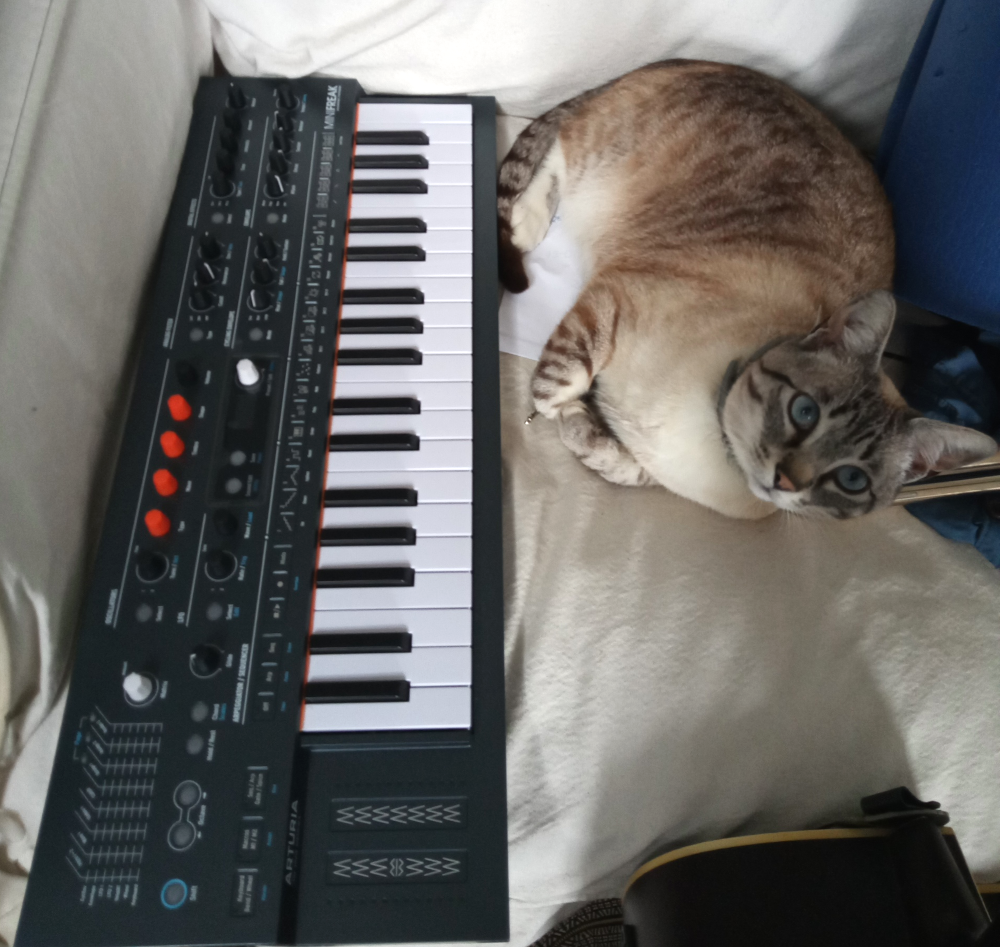
The Minifreak, by contrast, has a terrible Windows-only firmware update system, which works so poorly that I already had to the return the synth once to Arturia after a firmware update caused it to brick itself. There’s a stark lesson here in having open protocols which hopefully Arturia can pick up on. This synth has absolutely incredible sound design capabilities though so I decided to keep it and just avoid ever updating the firmware.
Here’s a shot of the Minifreak next to another mini freak: