call_end

    • chevron_right

      Research: Major Pirate Site Shutdown Boosted Visits to other Pirate Sites (and Netflix)

      news.movim.eu / TorrentFreak • 7 February • 4 minutes

    cueflix In November 2015, Federal Police in Brazil launched Operation Blackbeard, a coordinated action to take down Latin America’s most popular pirate site: MegaFilmesHD.net .

    Launched in 2010 and mainly catering to the Portuguese-speaking market, the movie portal had been pulling in a reported 60 million monthly visits.

    At the time, the site offered a type of convenience that most legal services couldn’t match. In addition to the free and unrestricted access to content, this also included localized features such as Portuguese subtitles or dubbing.

    This reign ended when police made several arrests, including the site’s presumed operators, and seized several cars, cash, and bank accounts. These actions were welcomed by Hollywood’s Motion Picture Association (MPA), which had reported the site to the U.S. Trade Representative a month earlier.

    MegafilmesHD in 2015

    Today, more than a decade has passed since MegafilmesHD’s demise, and online piracy is arguably a much bigger problem. Popular piracy brands such as Cuevana, Redecanais, and FlujoTV are a magnet for many millions of people

    This doesn’t mean that the original shutdown has no effect whatsoever. At the time, large local pirate sites were a novelty in the region, and, being the largest site by far, MegafilmesHD clearly stood out above the rest. When this went offline, many people had to scramble for alternatives, legal or illegal.

    Going Pirate or Going Legal?

    Ideally, rightsholders would like to see pirates flocking to legal services when these types of shutdowns occur. That is similar to the desired response to piracy site blocking. And indeed, in some instances, this appears to be true.

    For example, the “ Gone in 60 Seconds ” study found that the shutdown of Megaupload in 2012 resulted in a 6 to 10% increase in digital movie revenues for two major Hollywood studios.

    However, a similar study on the demise of the German streaming portal Kino.to revealed something quite different. The “ Catch Me If You Can ” paper found that this shutdown had no measurable increase in legal consumption. Instead, people simply switched to new pirate sites and continued their habit.

    These seemingly conflicting findings come together in a new study on the MegafilmesHD shutdown. While the associated paper doesn’t have a title inspired by a Hollywood blockbuster, it might as well have been titled “ The Equalizer “.

    “The Equalizer”: MegafilmesHD Shutdown Effect

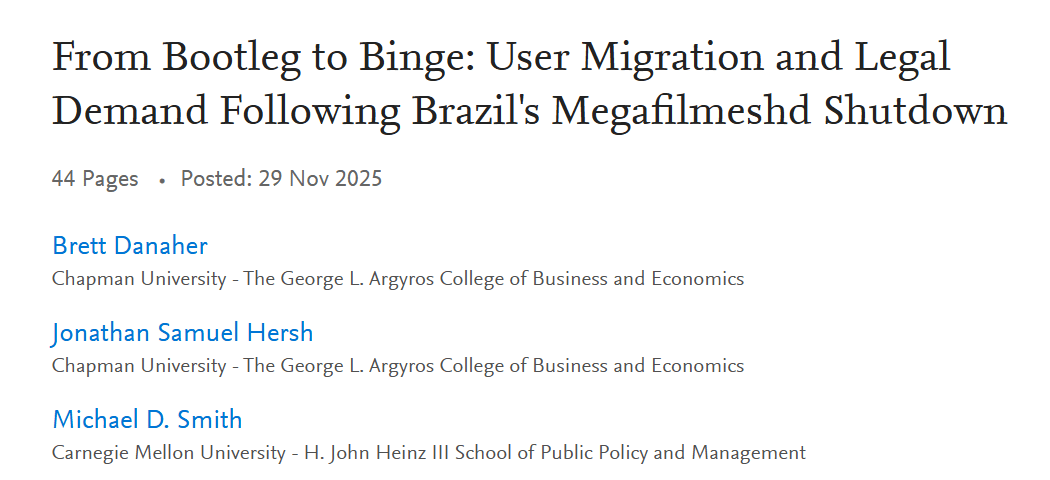
    The paper in question, published by researchers of Chapman University and Carnegie Mellon University, takes a detailed look at how the online activities of Brazilian users were affected by MegafilmesHD. To do so, they examined six months worth of clickstream data of thousands of Internet users, provided by Netquest .

    From Bootleg to Binge

    bootleg to binge

    The data included browsing patterns before and after the shutdown, and it included a wide variety of respondents, ranging from hardcore pirates to people who never visited MegafilmesHD at all.

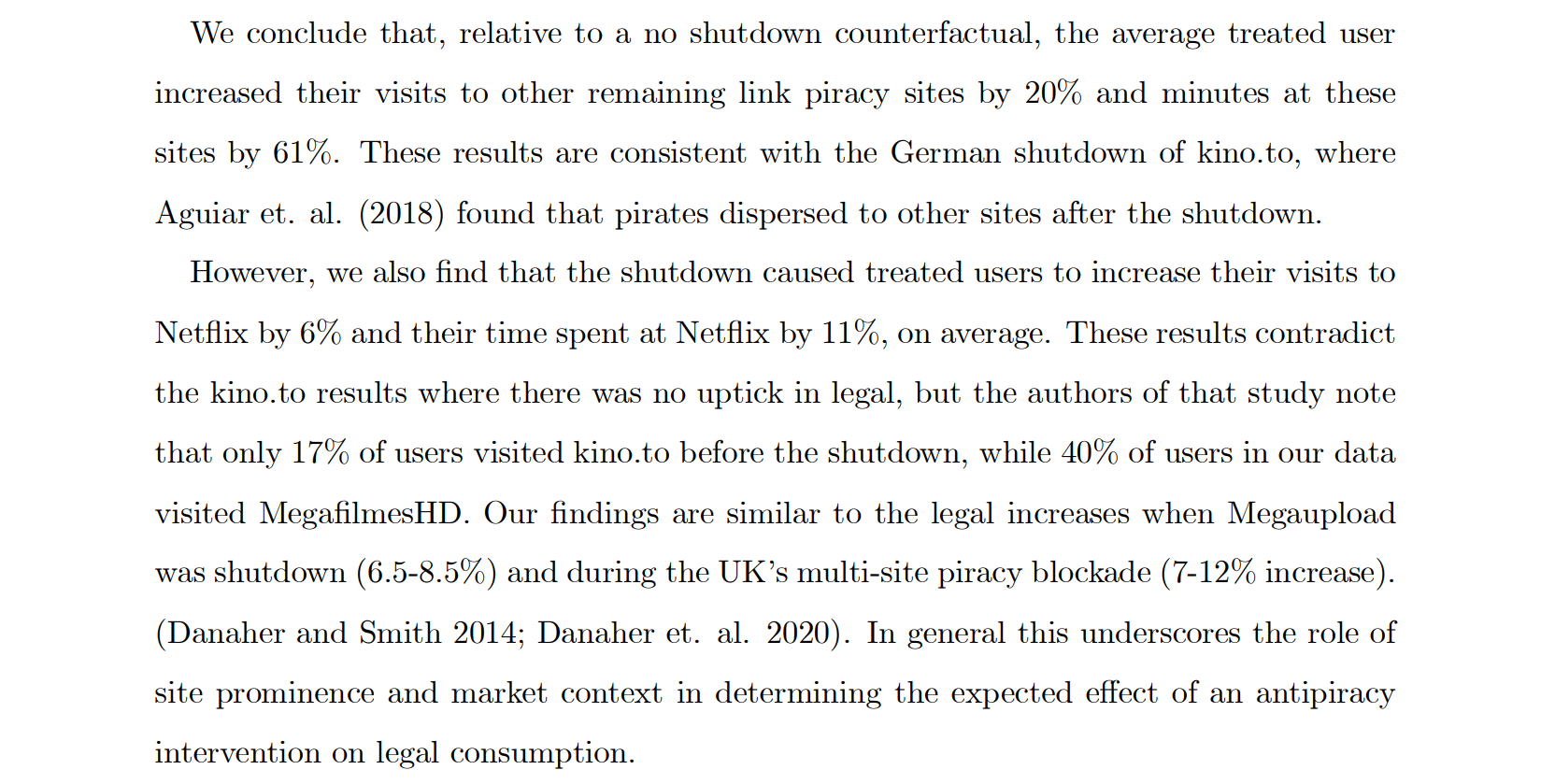
    After analyzing all data, the researchers found that pirates who previously used MegafilmesHD increased their visits to other pirate sites by 20% on average. Even more striking was the increase in engagement, as time spent on these alternative pirate sites surged by 61%.

    This effectively confirms that high-profile shutdowns divert traffic to other pirate sites and services. This makes sense, as a single shutdown can’t realistically make all piracy go away.

    However, the findings don’t end there. Additionally, the researchers also find a boost in legal use. Specifically, the data showed a 6% increase in visits to Netflix and an 11% increase in time spent on the platform among MegafilmesHD users.

    Key results

    results

    Crucially, this uptick wasn’t simply caused by existing Netflix subscribers watching more content. The researchers found a causal link between high MegafilmesHD usage and the probability of someone becoming a new Netflix subscriber in the months following the raid.

    The Wealth and Gender Gap

    While these findings may all seem logical, the most compelling part of the research covers which people switched to legal options and who remained pirates. It appears that “The Equalizer” effect was not felt equally across all demographics.

    Since costs play an important role, it makes sense that there’s a wealth factor involved. And indeed, the research found that students and unemployed individuals were less likely to sign up for Netflix, likely because price remains a primary barrier to entry.

    Interestingly, gender also plays a key role. The researchers found that women were more likely to stop piracy altogether following the shutdown. Men, on the other hand, were more likely to persist, often “doubling down” by searching for new illegal sources.

    It is these types of nuances that reveal the complexity of online piracy and the effectiveness of enforcement actions.

    Ultimately, the researchers conclude that while a single-site shutdown can generate measurable legal gains, those gains are in part limited to users who can afford the alternative.

    For rightsholders and policymakers, the “take-home” message is that enforcement is only half the battle. Without appealing and affordable legal alternatives, even the most successful police operation may be nothing more than another round of whack-a-mole, driving traffic from one pirate site to the next one.

    Danaher, B, Hersh, J, and Smith, MD. 2025. “From Bootleg to Binge: User Migration and Legal Demand Following Brazil’s MegafilmesHD Shutdown”. Review of Economics Research on Copyright Issues , Vol 22, pp 1-32.

    Note: This research was conducted as part of Carnegie Mellon University’s Initiative for Digital Entertainment Analytics (IDEA), which receives unrestricted funding from the Motion Picture Association (MPA). The authors note that all findings and any errors remain entirely their own.

    From: TF , for the latest news on copyright battles, piracy and more.

    • chevron_right

      Pirate IPTV Box Evades Blocking But is Also Critically Vulnerable to Attack

      news.movim.eu / TorrentFreak • 30 November • 6 minutes

    disaster-box Described by the MPA, Premier League and other rightsholders as a priority piracy threat, a set-top box available to buy right now on popular markets, initially sounds like an attractive buy.
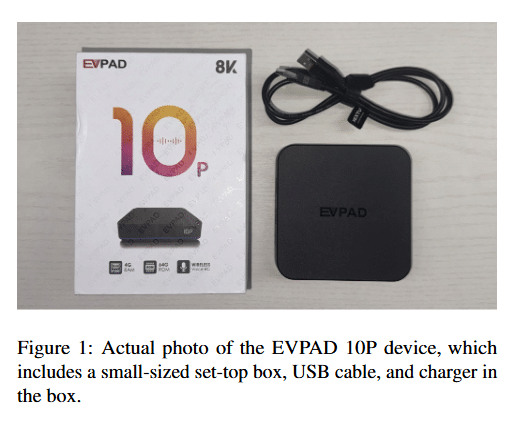
    Manufactured in China, EVPAD TV boxes look fairly unremarkable, and with an Android 7.0 operating system under the hood, they are. When purchased with a cheap ‘lifetime’ subscription, with installable apps providing access to all the content most people will ever need, looks become less important.

    However, a look under the hood reveals that the trade-off between content and privacy cannot be ignored.

    Researchers Investigate EVPAD

    Android-based EVPAD devices provide access to a huge library of infringing movies, TV shows, and live TV, sourced from countries including Canada, Taiwan, the UK, and the United States, among others. As a result, major rightsholders have regularly reported EVPAD and similar devices to the USTR’s Notorious Markets review.

    A team of researchers at Korea University took an interest in the EVPAD ‘3p’ and ’10p’ devices when considering what type of anti-piracy measures might be effective against device-specific apps, operating within closed, subscription-based networks.

    In this case, the EVPAD website advises buyers of the ‘3p’ device to download two apps from a third party website. ‘StarLive’ and ‘StarVod’ provide access to live TV broadcasts and VOD content, respectively. For the ’10p’ device, a single app called ‘StarV10’ is sufficient and in all cases, installation is simplicity itself.

    evpad3 “Interestingly, during the installation process from such unknown sources, the service applications are installed seamlessly without requiring any additional user interaction or explicit permissions,” the researchers report.
    “Upon further inspection, we found that the global system setting for package installation from non-market sources (install_non_market_apps) was set to 1, indicating that side-loading from unknown sources is universally permitted on this Android 7-based device.”

    For regular buyers, zero control over permissions should’ve been an immediate red flag. For the researchers, the secrets of obfuscated source code were still to be discovered.

    “Streaming is Safer Than Torrents”

    Since regular streaming is a process of consumption and the law tends to view supply more seriously, the theory that streaming is safer than torrents usually finds solid ground.

    That doesn’t necessarily mean that streaming pirated content is legal, but in a client/server streaming scenario, obtaining evidence of downloading meets technical challenges that aren’t easily overcome. In contrast, BitTorrent users upload by default, which makes evidence of a more serious offense comparatively easy to obtain.

    When people buy an EVPAD TV box, many will expect to ‘stream’ pirated content to the device. While that may be a part of the process, the reality is less straightforward.

    A Hybrid Network

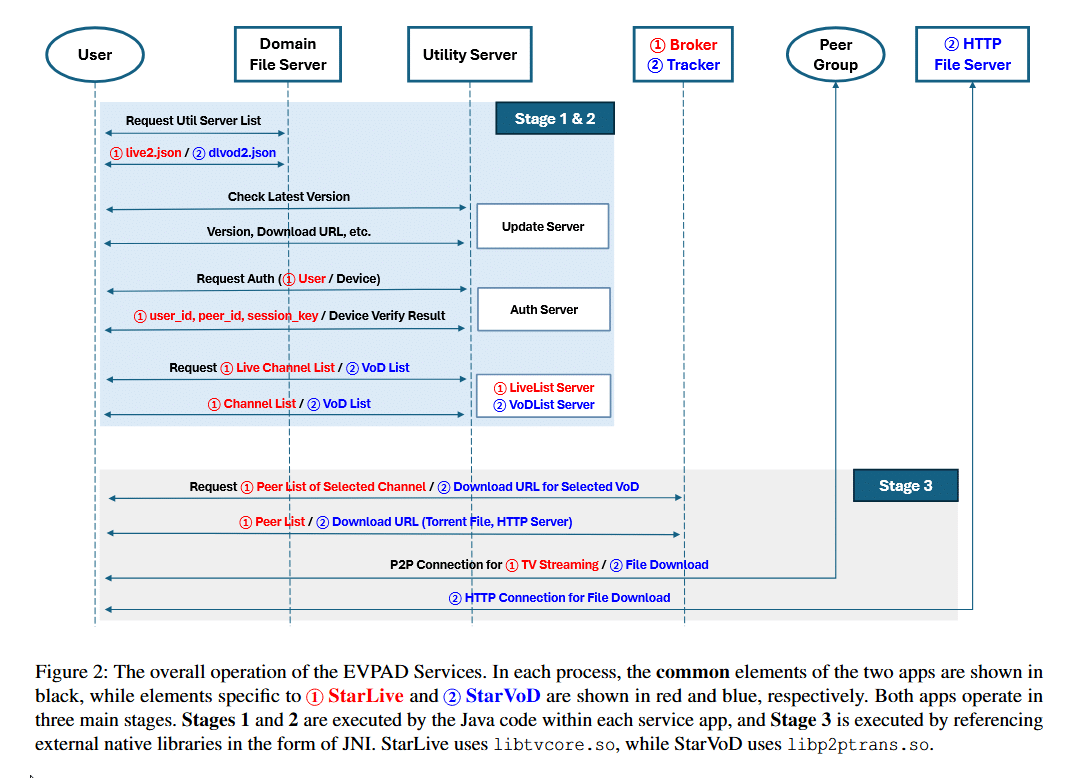
    The researchers at Korea University found that EVPAD devices initially communicate with centralized servers, which manage authentication, various updates, and the all-important content lists. Once obtained, EVPAD devices use that information to join a BitTorrent-like peer-to-peer (P2P) network , in which unwitting downloaders become simultaneous uploaders, or as they say in court, unlicensed distributors of infringing content .

    StarLive uses the ‘ libtvcore ‘ library to establish connections with other EVPAD devices, enabling real-time data sharing among peers, including the distribution of live TV broadcasts.

    Under the Hood evpad-dia1

    When a user of StarVod selects a video to watch, the system identifies a corresponding .torrent file and HTTP file server. Encrypted using XOR, the .torrent file is decrypted by the libp2ptrans library then used to perform standard BitTorrent functions, with a tracker providing a list of available peers.

    “Simultaneously, the user engages in both P2P communication with other peers and HTTP communication with the file server delivering the selected VoD title. This dual approach ensures both downloading and streaming, but in practice, HTTP streaming via a dedicated file server significantly enhances service availability and playback speed, often playing a major role in video streaming,” the researchers note.

    Hybrid Network Complicates Blocking

    This hybrid approach to networking complicates blocking efforts. While blocking certain domains would prevent service updates, that may not necessarily disrupt the P2P network.

    In the event that the source of content becomes unavailable, the researchers say that data broadcasting nodes in the P2P network provide a fallback mechanism by acting as servers within the ‘swarm’. For video-on-demand (VoD) content, the system utilizes P2P but when necessary, HTTP is used to reach servers operating as Content Delivery Networks.

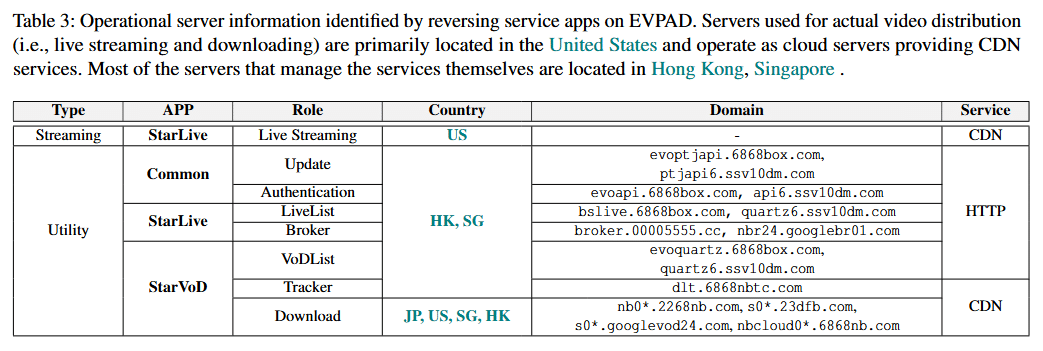
    “[These servers] distribute torrent files and video content, and the presence of multiple similar domains suggests that they are designed to quickly circumvent domain blocks. Additionally, there are domains and IP addresses for Trackers to facilitate torrent-based communication,” the researchers add.

    evpad-dia2

    After manipulating IDs used to identify content categories, the researchers obtained all VOD lists from the servers above, which together identified 24,934 pieces of video content. That included 1,052 movies and TV shows in the ‘Nflix’ category alone.

    Building Resilience Introduced Weakness

    No system is completely bulletproof, and this one is no exception. In theory, the decentralized nature of the P2P network makes the system more difficult to shut down. In practice, it also introduces vulnerabilities that can be exploited to disrupt the service.

    The researchers discovered two vulnerabilities. Using the Android emulator NoxPlayer to mimic an authenticated EVPAD device, the first allowed them to bypass authentication. This enabled content to be viewed from around the world, without a subscription, with the potential for “unlimited replication.”

    While the first vulnerability granted access to the network, the second vulnerability instantly denied it.

    “Given the critical nature of this vulnerability, we determined that even a single, carefully crafted TCP packet is sufficient for an individual to trigger service termination on a remote peer device. This drastically lowers the bar for potential abuse, as no significant bandwidth or coordinated effort is required,” the team note.

    Blocking Measures Disrupt the EVPAD Network

    When combined, these vulnerabilities form the basis of a theoretical anti-piracy strategy. Once a node is deployed in every available TV channel, the data normally used to connect peers can be leveraged for a different purpose. It allows an attacker to identify specific users and hit them with a TCP packet, causing an instant disconnection.

    There’s n o suggestion that such an attack has ever been used outside a lab environment. However, the researchers mention an injunction obtained in India by the Premier League that granted authority to block certain domains, which caused network disruptions lasting four days.

    While service was restored, the researchers say that would’ve been more difficult if additional capability had been deployed alongside.

    Implications For End Users

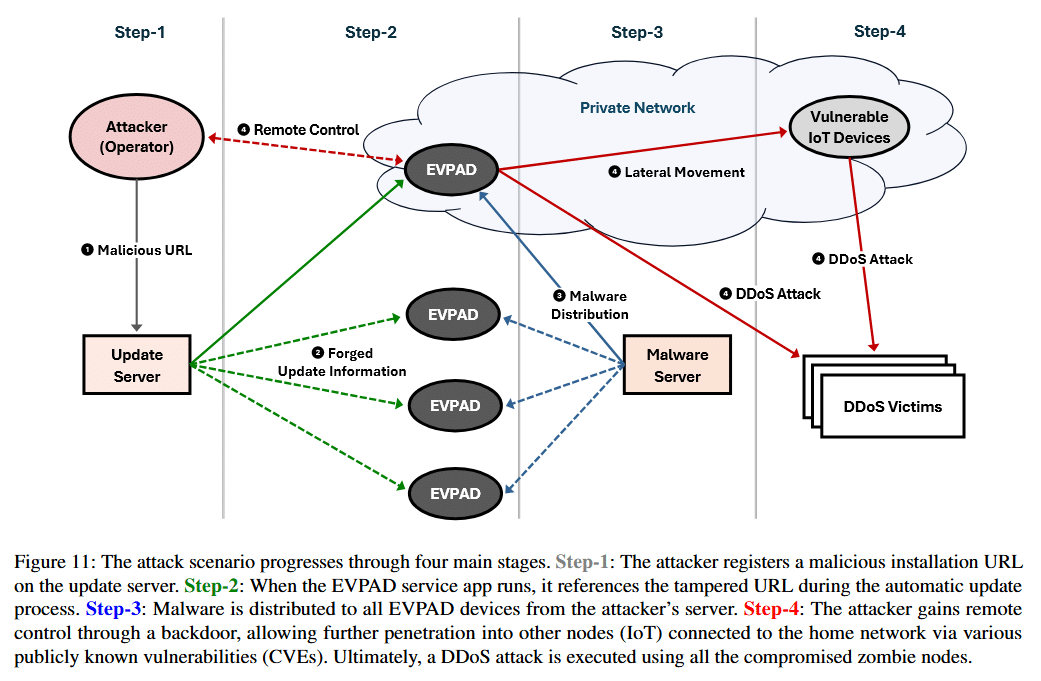
    Beyond the inherent risks of sharing copyrighted content, the implications for users of EVPAD devices are significant. Often distributed in a pre-rooted state with no package installation restrictions, EVPAD devices are highly vulnerable to abuse. The researchers found that the device update process lacks any mechanism to verify integrity or authenticity.

    The device also operates with SELinux in permissive mode , where policy violations occur without enforcement. These factors and others lead to the conclusion that attackers could secure a global network of “zombie” devices through which they could execute further attacks by remote control.

    evpad-dia3

    “At its peak, [the Mirai botnet] generated about 1TB of attack traffic using 145,000 devices,” the researchers note, adding that 17,000 compromised EVPAD devices could “potentially generate up to 0.12TB of malicious traffic at peak.”

    The study identified 131,175 devices across 116 countries and 78 operational servers located in the United States, Japan, Singapore, Hong Kong, and other countries

    “Even if malicious intent is not the primary motive, the lack of commitment to user security by such illegal operators places users in a vulnerable position, making them susceptible to attacks.”

    Watch Out Your TV Box: Reversing and Blocking a P2P-based Illegal Streaming Ecosystem, is available here ( pdf )

    From: TF , for the latest news on copyright battles, piracy and more.

    • chevron_right

      EUIPO Study: Major Brand Ads on Pirate Sites Surged 567%

      news.movim.eu / TorrentFreak • 20 November • 4 minutes

    fish For many pirate sites and apps, ad revenue is the only viable lifeline. This is why the advertising industry is an important ally in the fight against piracy.
    Over the years, several ad-focused anti-piracy initiatives and partnerships have tried to prevent branded ads from appearing on these sites.

    This includes a European Union-led Memorandum of Understanding (MoU) in which several leading advertising companies, including Google, signed up to play their part. The origins of this agreement date back to 2016, and the EU Intellectual Property Office ( EUIPO ) has monitored progress ever since.

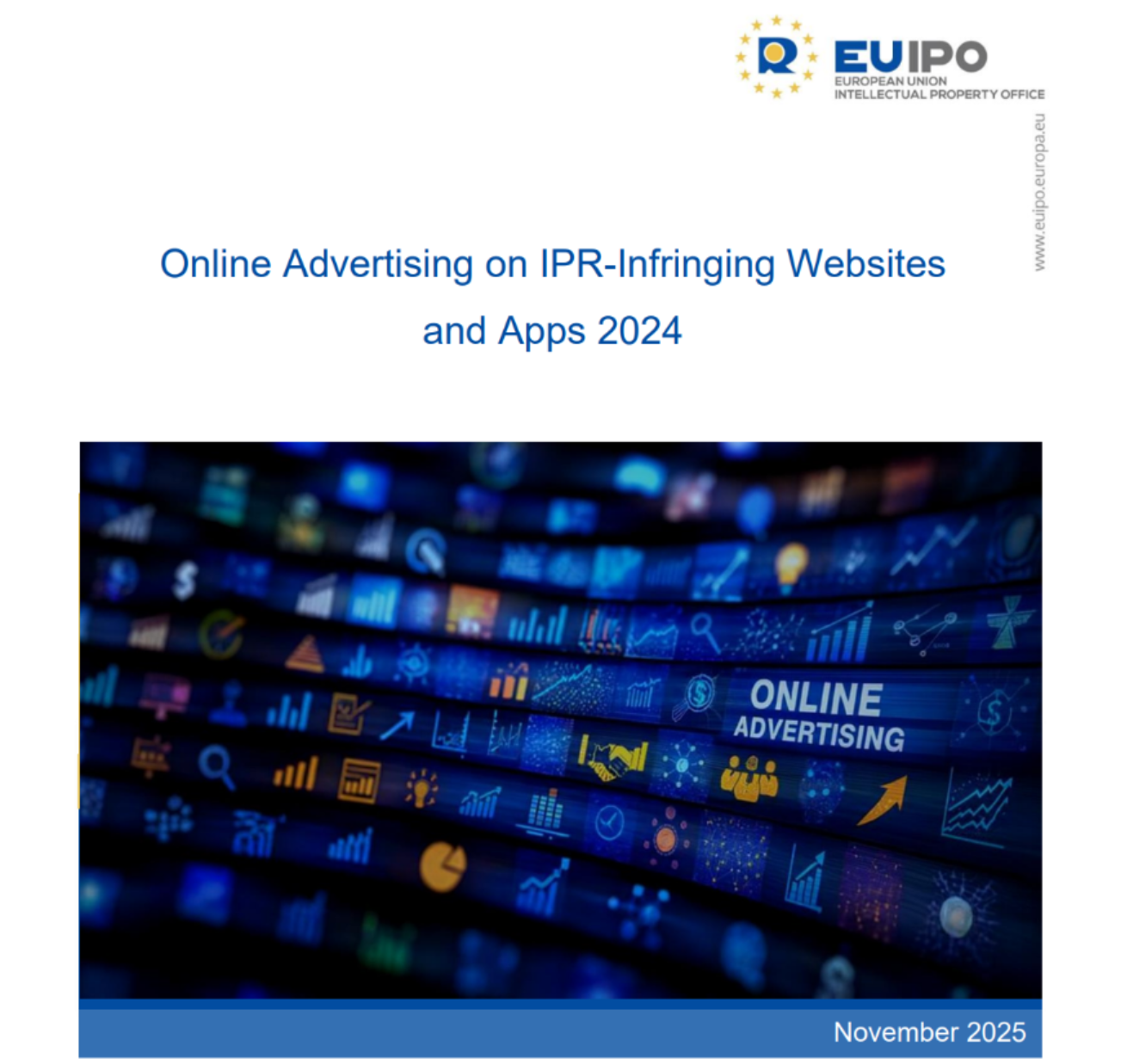
    The latest report on the state of the pirate advertising landscape was published this week . As in previous years, the EUIPO commissioned UK-based research firm White Bullet to provide a detailed overview of what types of ads appeared on pirate sites throughout 2024.

    The report: Online Advertising on IPR-Infringing Websites and Apps 2024

    euipo report

    The report looked at advertisements on 7,250 websites and 398 mobile applications across 18 EU member states. All ‘pirate’ sites and apps provided access to copyright-infringing content and were classified as either “illegal” or “high-risk”.

    White Bullet compiled a similar advertising report for EUIPO in 2021, which makes it possible to measure progress over the past four years.

    Major Brand Ads Surge 567% on Pirate Sites

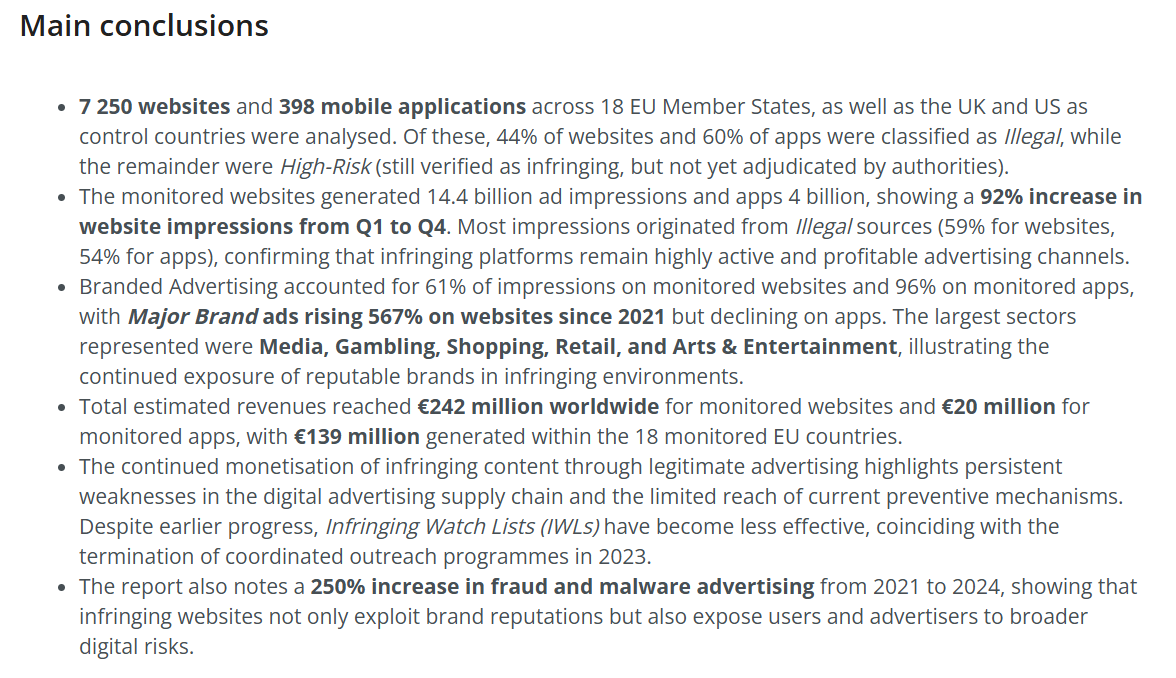
    The headline figures reported by EUIPO this week suggest that advertising volume on piracy sites grew rapidly throughout last year. Globally (EU+UK+US), the monitored websites generated 28.3 billion ad impressions over the year, with a 92% increase in impressions from the first to the fourth quarter.

    More concerning, perhaps, is that adverts run by major brands are still common on pirate sites. No names are mentioned in the report, but EUIPO notes that advertising impressions from major brands increased 567% between 2021 and 2024.

    Overall, branded advertising accounted for 61% of ad impressions on monitored websites and 96% on the monitored apps. This includes ads for both major and less-well known brands.

    The EUIPO highlights this significant increase in its “main conclusions” alongside some other concerning developments.

    EUIPO’s main conclusions

    main conclusions

    The report explicitly links this resurgence of major brand ads to a breakdown in industry cooperation, noting that education campaigns for advertisers were halted right before the spike occurred.

    “The massive growth in Major Brand advertising on IPR-infringing websites may be correlated with the 2023 termination of several coordinated outreach programmes focused on educating brands that had been placing advertising on IPR-infringing websites,” EUIPO’s report reads.

    It’s all Relative

    While the headline numbers reported by EUIPO are correct, they deserve some nuance. The number of ad impressions on pirate sites by major brands did not increase 567%; not by a long shot.

    What the report found is that major brand ads went from just 3% of all ad impressions on websites in 2021, to 20% of all ad impressions in 2024. While that technically represents a 567% increase in market share, the number of displayed ads tanked at the same time.

    Across all monitored countries, ad impressions on pirate sites crashed from 146.1 billion in 2021 to 28.3 billion in 2024. So, the total number of ads on these sites fell by roughly 80%.

    While the “567% increase” statistic is technically accurate when looking at relative market share, the increase is largely driven by the collapse of low-quality, non-brand ads. In real terms, the number of major brand ads served increased by roughly 30%.

    Fraud & Malware Increase/Decrease

    The same logic applies to a reported surge in fraud and malware advertising, which was also highlighted in the EUIPO’s main conclusions.

    “The report also notes a 250% increase in fraud and malware advertising from 2021 to 2024, showing that infringing websites not only exploit brand reputations but also expose users and advertisers to broader digital risks,” EUIPO writes.

    Again, this 250% increase is relative. Looking at the absolute numbers, fraud and malware ads actually decreased by roughly 1.8 billion impressions from 2021 to 2024. That’s roughly a ~31% reduction in malicious ads.

    The above makes it clear that absolute and relative comparisons can show an entirely different picture. This is largely attributable to a key change that took place over the past few years, which, strangely enough, is not mentioned in EUIPO’s main conclusions.

    EU: Pirate Ad-Impressions & Revenue Plunged

    The fact that the EUIPO report found an unprecedented 80% drop in pirate site ads receives very little attention. Yet, the numbers clearly show that, in the 18 monitored EU Member States, pirate site ad impressions also plunged: from 70.3 billion in 2021 to 14.4 billion in 2024 .

    The report links this drastic decline to an increasingly fragmented landscape of pirate sites, leading to lower traffic numbers overall. That sounds like a welcome result, but in the report the finding receives no obvious emphasis.

    The same applies to the associated decrease in advertising revenue for pirate sites. The report notes that the advertising revenues from the monitored countries dropped 78%, from €102.5 million in 2021 to €22 million last year .

    The Missing Number: €8.29 per day

    While the EUIPO focuses mostly on the relative increases of major brand ads and fraud advertisements, one key number was not highlighted. That is, the average estimated revenue these 7,250 sites generate per day from visitors in the 18 monitored EU countries.

    That number is not reported, but if we crunch the numbers, we see that the average pirate site generates roughly €8.29 per day from these EU users.

    The EUIPO report puts the global revenue of these sites at ~€91 per day. This leads to the logical conclusion that the EU advertising traffic only represents a fraction of the total income of these sites. That’s worth calling out, we think.

    The full report, which includes many more data points and intriguing statistics, is available here (pdf) .

    From: TF , for the latest news on copyright battles, piracy and more.

    • chevron_right

      Some Pirates Use Religion as an Excuse, For Others It’s a Moral Barrier

      news.movim.eu / TorrentFreak • 2 November • 3 minutes

    pirate-flag “Thou shalt not steal” is one of the Ten Commandments that many Christians hold in high regard, and other religions similarly condemn theft as a practice incompatible with religious teachings.

    In general, the public doesn’t view piracy as outright stealing or morally wrong. In fact, many people see ‘unauthorized copying’ as morally justified, even if it costs rightsholders billions.

    There are also religious people who pirate music, films, and software. While these people all have their own reasons, how they practice their religion appears to have a significant impact on how likely they are to pirate. In some cases, religion can even increase the tendency to pirate, a new study suggests.

    Research: Piracy & Religion

    A new paper titled “Software Piracy: The Effects of Neutralization and Religiosity,” published in the Journal of the Southern Association for Information Systems, investigates how an individual’s religious beliefs affect their intention to engage in software piracy.

    The paper

    religious research

    Researchers from Pittsburg State, Kansas State, and Oklahoma State University developed a model combining religiosity theory with neutralization to examine how the effect of religion on piracy intentions can differ.

    The research draws on the psychological distinction between intrinsic and extrinsic religiosity, which differs from person to person.

    Intrinsic religiosity typically involves deeply internalized religious beliefs and living one’s life according to those beliefs. Extrinsic religiosity is more focused on using religion for personal or social benefits, such as being a respectable member of the community, identifying with a religious group, or finding psychological comfort in faith.

    The researchers hypothesized that how people identify with their faith will affect their intention to engage in piracy. This was tested in a survey among 338 undergraduate business students in the United States, who had to review a software piracy scenario and were asked to rate the likelihood that they would do the same.

    Religion Impacts Piracy Habits

    The findings show that the degree of intrinsic and extrinsic religiosity has a significant impact on the intention to pirate.

    Intrinsic religiosity was negatively correlated with the intention to pirate. This suggests that individuals who have deeply internalized religious and moral values are less likely to pirate software.

    Extrinsic religiosity correlated positively with the intention to pirate software. This implies that individuals motivated by the social or utilitarian benefits of religion may be more likely to justify unauthorized downloading of software.

    The driving factor behind these findings is the use of rationalization techniques or, boldly put, excuses. Those who pirate typically come up with rationalizations for their behavior, and that’s also shown by the research. Three rationalization techniques were significant predictors of piracy intention.

    rationalization techniques

    Condemn the Condemners: Justifying piracy by viewing software companies as greedy or copyright laws as unfair.

    Appeal to Higher Loyalties: Rationalizing piracy as helping friends or promoting free culture.

    Metaphor of the Ledger: Focusing on good deeds in other areas of life that compensate for their piracy actions.

    The researchers conclude that these rationalizations can directly involve religion for those who have an extrinsic religious orientation.

    “Those with extrinsic religiosity are more likely to have utilitarian motives and are less likely to have genuine ethical intentions. If I attend church and do other good things, then it is all right if I pirate a little software now and then (metaphor the ledger),” the paper reads.

    The Anti-Piracy Gospel

    In addition to these key findings, the study also confirmed earlier research finding that men are more likely to pirate than women, and that older people are less inclined to pirate software than their younger counterparts.

    The research shows that people’s tendency to pirate is influenced by a combination of internal moral compass and the ability to rationalize piracy. That said, the findings are based on a sample of business students, which means that they may not be representative of the general population.

    Intriguingly, the researchers suggest that their findings could make it worthwhile to involve religious organizations in anti-piracy campaigns.

    “Religious organizations can play a key role in educating communities about the ethical issues of piracy by using sacred teachings to promote honesty and respect for others’ work. They can address piracy in sermons, host educational workshops, and incorporate digital ethics into youth programs,” they write.

    Whether any anti-piracy groups are eager to pick this up is unknown.

    Sikolia, D., Bahr, G., & Biros, D. (2025). Software Piracy: The Effects of Neutralization and Religiosity. The Journal of the Southern Association for Information Systems, 12, 1-17. https://doi.org/10.17705/3JSIS.00038

    From: TF , for the latest news on copyright battles, piracy and more.

    • chevron_right

      ‘Fear of Looking Cheap’ Can Deter Sports Piracy, But Piracy Stats Can Backfire

      news.movim.eu / TorrentFreak • 12 October, 2025 • 4 minutes

    tv Over the years, we’ve witnessed dozens of anti-piracy campaigns. Despite these efforts, reported piracy rates appear to increase, seemingly undeterred.
    Research has indicated that piracy is a complex phenomenon that’s not always easy to grasp. However, understanding the motivations of pirates can be key to changing their behavior, new research suggests.

    Piracy Study: Social Risks & Norms

    An academic study recently published in Frontiers in Behavioral Economics, explores the social drivers of digital piracy, focusing on gender differences. The research, conducted by Kate M. Whitman and Joe Cox, looked at how perceptions of social norms and risks can impact people’s intention to pirate.

    The rising tide of piracy

    paper titled the rising tide of piracy

    The researchers tackled the issue from two different angles, using an online survey of 684 participants.

    First, they looked for a link between participants’ personal feelings and their past piracy consumption. They then checked if this was linked to people’s perceived “social risk,” including concerns that pirating would make them look cheap or unethical.

    For the second angle, the researchers tested if they could change people’s minds about their future behavior. The respondents had to guess how common piracy is, and some of them were then shown the real piracy rate, taken from a large UK government survey.

    This setup effectively created two experimental groups. One was explicitly told that their estimate of the piracy rate among their peers was “too high”, while the others were informed that theirs was “too low”. Finally, a control group received no comparison message at all.

    Men Pirate More

    The results of the study confirm the existing perceptions on gender differences. Men use pirate sources more often when they consume music or live sports, which are the two content categories addressed in the research.

    In the music category, the rate was 3% for women versus 7% for men. The gender gap was even more pronounced for live sports, where men say that 21% of their consumption comes from pirate sources, compared to 8% for women.

    “These results show that even when controlling for legal demand, men tend to pirate more than women. They also show that live sport consumers derive more of their consumption from illegal sources than music consumers,” the researchers conclude.

    “Social Risk” & The Fear of Looking “Cheap”

    The study also examined the link between perceived social risk and piracy. This was measured by asking to what degree friends and family would think the respondent was “unethical,” a “criminal,” or “couldn’t afford legal content” if they knew they pirated.

    The perceived social risk score was not correlated with music piracy for men and women. Whether they pirated a lot or barely at all was not linked to these social drawbacks.

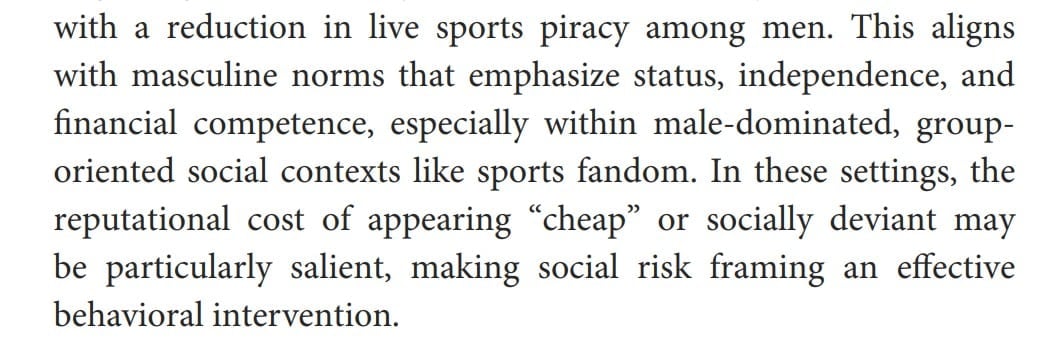
    For live sports piracy, however, higher perceived social risk was associated with a lower piracy rate, particularly among men. While this is a correlational finding, the researchers suggest that it may be due to male sports culture.

    “This aligns with masculine norms that emphasize status, independence, and financial competence, especially within male-dominated, group-oriented social contexts like sports fandom.

    “In these settings, the reputational cost of appearing “cheap” or socially deviant may be particularly salient,” the researchers add.

    Appearing cheap

    appearing cheap

    Experiment: Piracy Statistics Can Backfire

    The second part of the study was an experiment. It examined whether explicitly pointing out that people over- or underestimate the piracy statistics of their peers, would change their intention to pirate in the future. This led to some key results.

    Those who overestimated the official Government data, thinking that piracy was more common among their peers, did not change their future piracy plans. That was true for both men and women.

    Intriguingly, however, men who had underestimated how common piracy was increased their willingness to pirate in the future after they were informed that piracy is more prevalent than they thought. On women, this had little effect.

    This means that campaigns, studies, and other reports that highlight how widespread piracy is, can actually backfire. Some men may see this as a justification to pirate more themselves.

    “These findings highlight the risks of campaigns that emphasize how common piracy is, particularly among men, without considering how such information may inadvertently normalize and license the behavior,” the researchers write.

    Limitations and Future Research

    While these findings are new and noteworthy, this type of research, which relies on self-reported intentions and behavior, always comes with caveats. The authors of the paper realize this and mention it as one of the limitations.

    For example, the social risk questions were asked before participants reported their past piracy behavior. This may have primed participants, influencing their own piracy score.

    While not directly mentioned in the paper, the experimental part of the study could also be impacted. By putting participants in a “social risk” mindset, it may have influenced how they estimated peer piracy rates, systematically affecting who was placed in the “underestimator” and “overestimator” groups.

    All in all, the study presents a clear takeaway for anti-piracy organizations. For decades, campaigns have focused on highlighting the massive scale of the piracy problem, but this research suggests that revealing how common piracy is could actually backfire.

    Whitman KM and Cox J (2025) The rising tide of piracy: the influence of social roles, risks and norms on illegal consumption. Front. Behav. Econ. 4:1631329. doi: 10.3389/frbhe.2025.1631329

    From: TF , for the latest news on copyright battles, piracy and more.

    • chevron_right

      Takedown Notices for Pirate Live Streams Skyrocket, But Why?

      news.movim.eu / TorrentFreak • 11 September, 2025 • 5 minutes

    ballnetblock Earlier this year, accounting firm Grant Thornton published a report in partnership with the Live Content Coalition to evaluate the effectiveness of takedown notices.

    One of the main conclusions was that, in 2024, only a small fraction of takedown notices sent by a group of select rightsholders resulted in suspensions of pirated live streams.

    Of the 10.8 million notices recorded last year, only 19% resulted in suspensions of pirated live streams. Even when online services responded, it often took more time than rights holders would like. Only a small fraction of the reported live streams, 2.7%, were suspended within 30 minutes of a takedown notice being sent.

    These findings were used by rightsholders to argue that current policy doesn’t work. They hoped that by sounding the alarm bell, things would change, but new data covering the first half of 2025 doesn’t provide any evidence that this is the case.

    More Takedowns, Fewer Suspensions

    In a new industry-backed report, Grant Thornton finds that the number of takedown notices sent to online intermediaries grew by more than 15 million in the first half of 2025, which is roughly triple the number of takedowns that were recorded in the two previous periods.

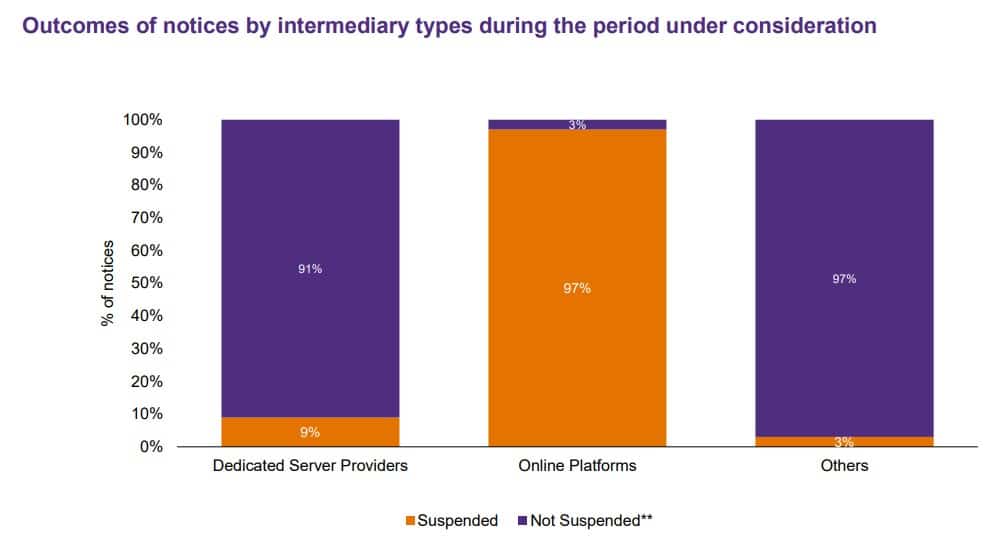
    The bar chart below shows that in 2025, the majority of the notices were sent to “other” service providers, which includes Cloudflare. Dedicated service providers were good for 42% of the notices, while online platforms only received a tiny fraction.

    The report regularly combines the 2025 findings with those from last year’s reports, noting that since January 2024, rightsholders have sent 26.2 million takedown notices for live streaming broadcasts. While the suspension rate was 19% in the second half of 2024, that figure decreased to just 5% in the first half of 2025.

    The bar chart below displays the actions per intermediary, revealing that the low percentage of suspensions is largely driven by the popular “others” category. This category includes proxy services such as Cloudflare, which typically takes no action when the allegedly infringing content is not hosted by Cloudflare itself.

    suspended

    Based on the new findings, the report concludes that “online piracy continues to escalate, while progress in the effectiveness of mitigation efforts remains limited.” While this appears to be a logical conclusion, there are some important caveats.

    Methodological Concerns

    The report is based on data provided by ten rightsholders, who are either major sports leagues or broadcasters. This is an increase of two rightsholders over the eight featured in the previous report, which likely has an effect on the takedown notice volume, regardless of piracy developments.

    These companies have direct control over how many notices they send and can, in theory, increase the volume while piracy rates are falling.

    This means that the drastic increase in notices might mostly be a reflection of increased or improved enforcement efforts, rather than an unprecedented tripling of the number of available pirated live streams.

    There’s also a clear bias risk. These rightsholders have a vested interest in showing that piracy is a large and worsening problem, to support their lobbying efforts for stricter regulations. The methodology does not account for this.

    The inclusion of Cloudflare as a nonresponsive intermediary also raises questions. It is well known that Cloudflare does not take action against reported pirated content that it doesn’t host. The company believes that, under U.S. law, it is not legally required to do so for its proxy services.

    By including an ever-increasing number of notices sent to services like Cloudflare, which they know will not result in a suspension for policy reasons, the report’s methodology effectively “bakes in” a lower success rate.

    Although the data is not inaccurate, it’s less of a measure of the evolving piracy landscape than it is a reflection of the rightsholders’ enforcement strategy, particularly their decision to target Cloudflare and similar platforms, which are known for not taking action.

    LaLiga Rethinks Its Headline

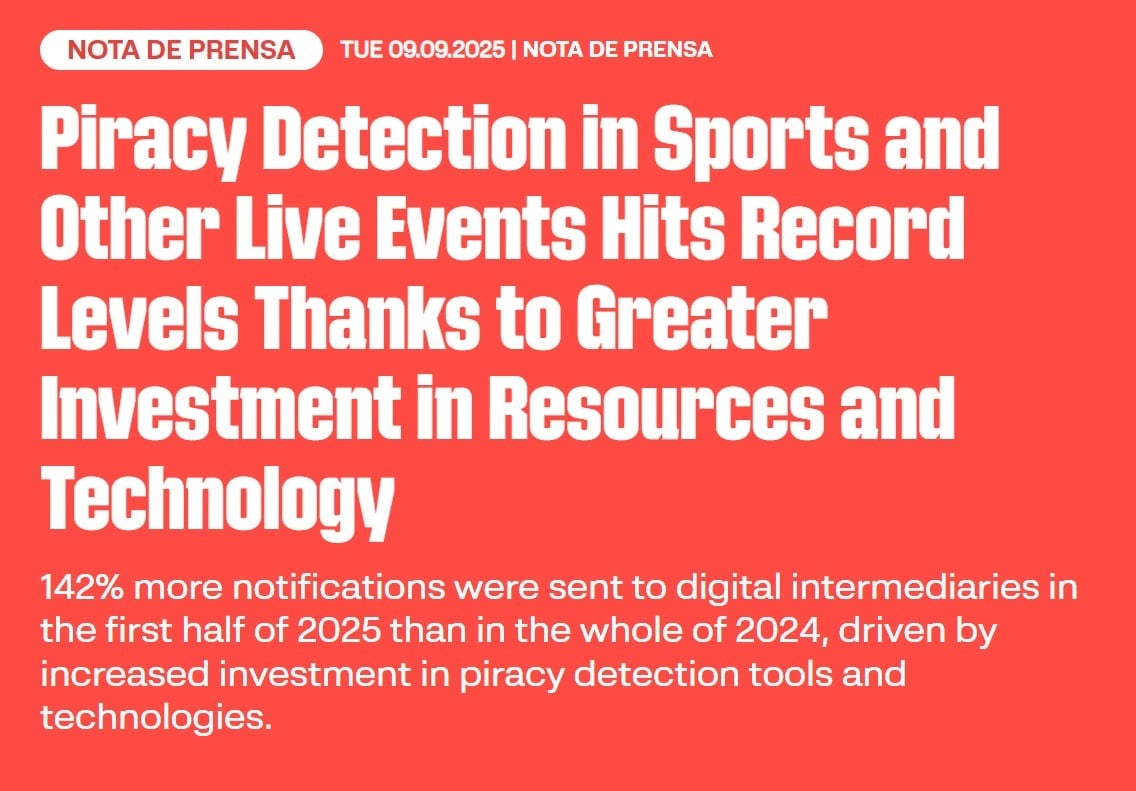
    That the report leaves room for multiple explanations, or framing options, was illustrated by the Spanish football league LaLiga. On Tuesday, it initially pushed out a concerning press release mentioning that “piracy of live sports events soars”.

    Original headline

    laliga headline

    That’s not completely accurate, however, as the research only looks at the volume of takedown notices. It appears that LaLiga understands this nuance, as the headline was changed a few hours later to: Piracy Detection in Sports and Other Live Events Hits Record Levels Thanks to Greater Investment in Resources and Technology

    The updated LaLiga headline

    laliga headline

    This new headline suggests that the ‘escalation of online piracy’ reported by Grant Thornton, might be an escalation in anti-piracy detections, rather than an increase in piracy. That’s quite an important distinction, considering its intended goal.

    EU Advocacy

    The report was written specifically to address the impact of a recommendation by the EU Commission published two years ago. This policy document encouraged member states to introduce measures to facilitate prompt takedowns of live streams.

    The recommendation, which doesn’t include any legislative requirements, also encouraged service providers and rightsholders to collaborate and tackle the challenge together.

    In its report, which references the EU’s non-binding recommendation in its title, Grant Thornton indirectly suggests that it failed to curb the negative piracy trends.

    “During the period of analysis, there has been a negative trend in key metrics, such as an increase in the number of notices issued and a decrease in the percentage of those resulting in suspension.

    “This suggests that, despite the European Commission’s Recommendation, the issue of online piracy continues to escalate, while progress in the effectiveness of mitigation efforts remains limited,” the report concludes.

    The report

    report

    This is an interesting conclusion, since LaLiga now cites the same takedown data to show that piracy detection hit record levels with help from investments in resources and technology. That means that piracy itself may not have worsened at all.

    When the data is this flexible and open to interpretation, the cleanest and only truly verifiable conclusion is simple. In the first half of 2025, a small group of rightsholders sent a lot more takedown notices. Why? That depends on who you ask and what their goal is.

    A copy of the latest progress report, titled “Two Years On: Online Piracy Trends Worsen Despite the European Commission’s Recommendation” is available here (pdf)

    From: TF , for the latest news on copyright battles, piracy and more.

    • chevron_right

      UK Live Sports Piracy Sets New Record, Movie Piracy Returns to 2019 Peak

      news.movim.eu / TorrentFreak • 23 August, 2025 • 5 minutes

    The Online Copyright Infringement Tracker (OCI) has provided data on piracy carried out online for more than a decade. After publication of Wave 12 in 2022 , there was no report covering 2023.

    The latest Wave 13 edition covers online infringement in 2024, spanning various categories including movies, music, TV shows, and live sports. The online survey component was conducted among a representative 5,000 person sample of the UK population aged 12 and above.

    OCI Wave 13 (2024)

    The headline figure reveals a small decrease in the overall piracy rate, from 32% in 2022 to 29% in 2024. This figure represents the proportion of the total sample who had accessed any online content illegally during the previous three months. While any improvement will be welcomed by rightsholders, the authors of the report say the figure should be interpreted with caution due to the addition of new content categories and methods of access.

    The software category showed the most progress, with the infringement rate falling from 38% in 2022 to 31% in 2024. Audiobook piracy developed in the opposite direction, increasing from 22% in 2022 to 30% last year.

    In most of the other categories, infringement rates are close to those reported two years ago. Live sports, software, digital magazines, and audiobooks show above average piracy rates, and music, TV, video games, and ebooks, all show rates below average.

    ↑ Music Piracy Infringement Rate ↑

    Music infringement rates increased marginally from 25% in 2022 to 26% in 2024. The figure relates to those who used a mix of legal and illegal sources in the preceding three months.

    oci-music-inringe-trend-wave13

    This means that for the last two waves, the overall piracy rate for music has stayed above the 24% rate reported in 2015, which preceded several year-on-year reductions. (red line denotes change in methodology)

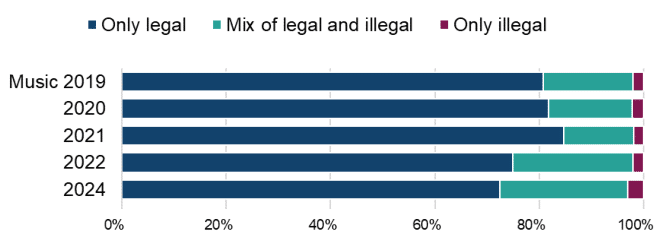
    In 2019 and 2020, the number of listeners consuming exclusively from legal sources showed slight increases, with those consuming exclusively from illegal sources remaining fairly static. Since then, legal-only consumers have fallen, with the percentage of respondents consuming from illegal sources increasing compared to previous years (47% vs. 45%).

    oci-wave13-music-sources2

    In 2024, 53% of respondents said they only accessed music legally, with less than half (19%) relying exclusively on piracy.

    Downloading was the dominant method used to access pirated music in 2024, with just 2% of respondents streaming using a mix of legal and illegal sources. No respondents reported streaming illegally. Overall, it’s estimated that around eight million people pirate at least some music in the UK

    ↑ Movie Piracy Infringement Rate ↑

    In 2024, the overall infringement rate for movies continued on an upwards trend, from 24% in 2022 to 27% in 2024.

    oci-wave13-movies

    This three percentage point increase means a return to the highest overall movie piracy infringement rate recorded back in 2019. That high of 27% was due to an eight point shock increase over the rate reported in 2018 (19%), which in turn was the lowest rate recorded since 2015.

    oci-wave13-movie-sources

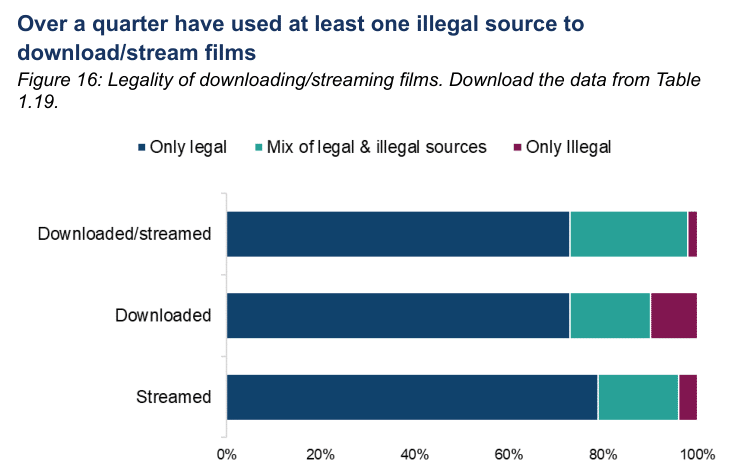
    Wave 13 data (2024) shows 73% of respondents downloading movies exclusively from legal sources, with 17% utilizing both legal and illegal. One in ten (10%) respondents pirated everything they consumed.

    Infringement via streaming sources was relatively low, with 17% mixing legal/illegal and just 4% obtaining everything from illegal sources. In Wave 12 (2022), 83% of respondents said they relied solely on legal sources to stream movies, a figure that dropped four points to 79% in Wave 13 (2024).

    → TV Piracy Infringement Rate ←

    In 2024, the overall infringement rate for TV shows was 19%, unchanged from the previous wave in 2022.

    oci-wave13-tv

    While significantly higher than the 14% recorded in both 2020 and 2021, today’s overall piracy rate for TV content remains lower than the 21% recorded nine years ago.

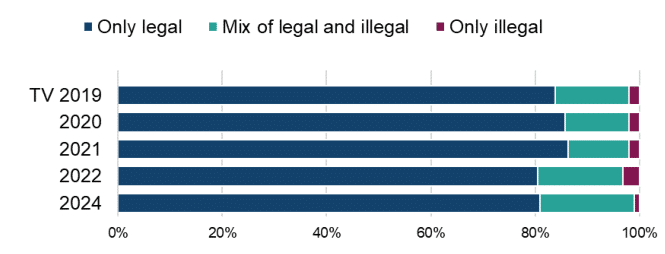
    The data on consumption sources shows 80% of respondents downloading exclusively from legal sources in 2024.

    oci-wave13-tvsources

    This represents a marginal improvement over figures reported in 2022, which had deteriorated following an all-time high in 2021. Those who downloaded all TV content illegally sat at 8% in 2024, with 11% downloading from a mix of legal/illegal sources.

    The study found little change in the rate of TV show infringement purely via streaming, with 13% using a mix and just 2% using illegal sources exclusively.

    ↑ Live Sport Piracy Infringement Rate ↑

    In 2024, the overall infringement rate for live sports was 38%, an increase of two points over the previous wave in 2022.

    Live sports consumption appeared in its own category in the OCI tracker for the first time in 2019 and, apart from a Covid-related dip in 2021, has shown consistently high rates of infringement.

    oci-wave13-live-sports

    The latest figure of 38% in Wave 13 has the dubious honor of being the highest rate recorded since 2019. While this isn’t considered a significant increase in the study, data on the sources used to watch live sports may be a cause for concern.

    oci-wave13-live-sports-sources

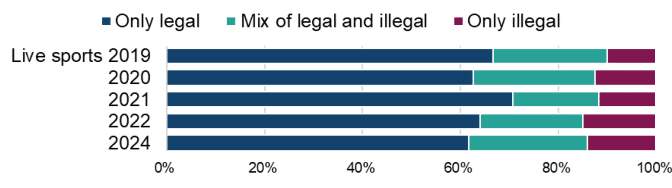
    Data from 2024 shows a decrease in legal-only live sports consumption (62% of respondents in 2024) and a similar one point decrease in exclusively illegal consumption to 14% (15% in 2022). The study provides additional context:

    • Exclusive use of illegal sources highest among those aged 16-24 (28%)
    • Exclusive use of illegal sources in other age groups (8% to 20%)
    • Those with a high passion for live sport are most likely to infringe (44%)

    While use of paid subscriptions to music streaming services increased by 3% (57% of respondents), paid subscriptions to sports streaming platforms fell by 8% in 2024 (51% of respondents). Meanwhile, paid subscriptions to pirate IPTV providers to access live sports were up 4% and used by 12% of respondents.

    “In the qualitative phase, some participants mentioned having to abandon subscriptions to live sports, due to managing this cost alongside other increasing costs,” the study’s authors reveal.

    “Participants suggested that, in the future, they would need to further decrease their consumption of live sports subscriptions and settle for free broadcasts on terrestrial TV.”

    Headline Figures & Key Drivers of Infringement

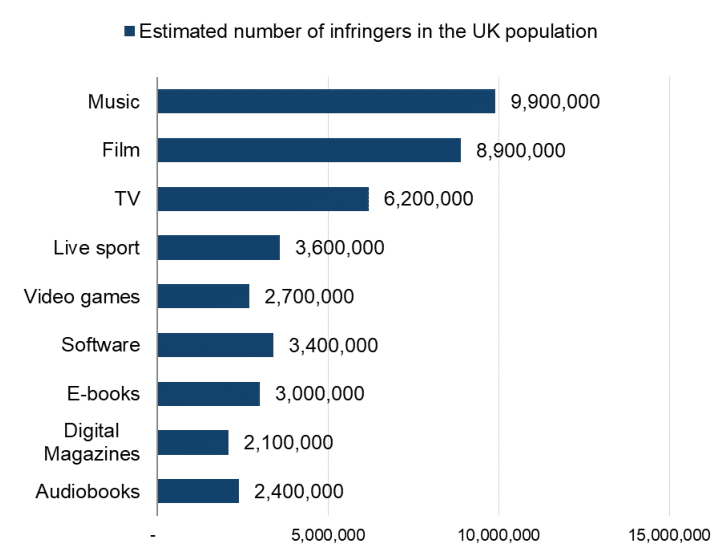
    The study found that music is pirated by more people than any other media, 9.9 million in total. An estimated 8.9 million people pirate movies, with 6.2 million getting their TV fix from pirate sites.

    Live sports piracy is yet to topple the three main categories, but with 3.9 million people getting at least some events for free, the numbers are significant.

    oci-total-infringers-wave 13

    No real surprises or big changes in the dominant categories, but there’s potential for live sports to continue on an upward trend, and with an eight-point increase, audiobooks seem like a category to watch.

    oci-overall-wave13

    The study suggests that the rising costs of living, which include increased prices for music, TV/film, and video games subscriptions, all contribute to infringement levels.

    The perception of unfair or high pricing for legal services, especially when multiple subscriptions are required, is cited as a main driver for illegal content access, with saving money the key benefit.

    The Online Copyright Infringement Tracker Survey (13th Wave) is available here (ODT)

    From: TF , for the latest news on copyright battles, piracy and more.

    • chevron_right

      Sports Piracy Damages Soar in Italy Despite ‘Piracy Shield’ Blocking Efforts

      news.movim.eu / TorrentFreak • 21 June, 2025 • 3 minutes

    pug Last year, Italy officially implemented the ‘ Piracy Shield ‘, a system that aims to deter and decrease live sports streaming piracy.

    Since then, Piracy Shield has blocked access to thousands of IP-addresses and domain names associated with unauthorized broadcasts.

    Despite overblocking concerns , the massive blocking operation is seen as a key success by the authorities and many participating rightsholders. The same is true for the updated copyright law in general, which introduced fines of up to €5,000 for pirate consumers.

    Study Reveals Piracy-Shield Impact

    While there is no shortage of opinions on these measures, hard data on the impact of the increased anti-piracy efforts is less common. Initial data indicated that the Piracy Shield had little impact on legal subscriptions, but thorough research is lacking.

    This week, new data from IPSOS adds more context. The IPSOS survey and report have been published annually for several years in collaboration with local anti-piracy outfit FAPAV . The most recent version covers 2024, which is the first year Piracy Shield was active.

    A quick glance at the headline numbers suggests a trend going in the right direction. In the span of a year, overall piracy rates decreased, especially among teens. The same is true for piracy volume, which dropped significantly.

    Piracy Trends in Italy: 2023 vs 2024

    Data sourced from the FAPAV/Ipsos surveys.

    Metric 2023 Survey Data 2024 Survey Data
    Overall Piracy Rate (adults) 39% 38%
    Teen Piracy Rate (10-14 years) 45% 40%
    Pirates Converting After Block 45% 47%
    Piracy Volume (Total Acts) 319 Million 295 Million

    As shown above, pirates are increasingly converting to legal services after encountering a block. Nearly half of all pirates who ran into a blocked site or service reportedly sought legal options, which is a notable success. However, since the piracy rate only dropped a single percentage point in a year, piracy remained prevalent.

    This brings us to some of the seemingly disappointing outcomes of the survey, including the prevalence of live sports streaming piracy, which is the main target of the Piracy Shield program.

    The report finds that in 2024, 15% of the population had used pirate live sports streaming services at some point, which is the same figure as a year before. In other words, sports piracy did not decrease after the Piracy Shield launched.

    When compared to 2023, prevalence of most types of piracy remained relatively stable, with a few single percentage point drops here and there. Of the researched content categories, film piracy was the most common with 29% of the population admitting to have pirated something in 2024.

    Comparison of Piracy rate by Type

    Percentage of the adult population in Italy that engaged in each type of piracy at least once during the year.

    Type of Piracy 2023 Rate 2024 Rate
    Overall Piracy (any type) 39% 38%
    Film Piracy 30% 29%
    Series Piracy 22% 23%
    Software Piracy 21% 22%
    Live Sports Piracy 15% 15%
    Illegal IPTV Use 23% 22%

    These percentages mostly apply to online piracy, but also include physical piracy and indirect piracy. The latter refers to receiving pirated content from another person, such as via a USB drive or by watching someone else’s copy.

    Volume Down, Damages Up

    While there was no drastic decrease in the piracy rates, the positive note is that the overall piracy volume dropped more significantly. The reported 295 million piracy ‘acts’ in 2024 represent an 8% drop compared to the year before.

    On the flip side, however, the reported financial damages increased. Across all sectors, the study estimates the loss in turnover at €2.2 billion, a substantial 10% increase year over year.

    The most dramatic increase is reported in the live sports streaming category. These losses were estimated at €285 million in 2023 and €350 million last year, a 23% increase. That’s despite the Piracy Shield measures, which are aimed at sports piracy.

    Awareness

    Piracy Shield definitely didn’t go unnoticed by the public at large, as the survey reveals that 70% are aware of the new anti-piracy law, which also introduced financial penalties for individual pirates.

    For now, the law’s looming punishments lack deterrence, as 42% of the population doubts its effectiveness. At the same time, only 56% of the self-proclaimed pirates believe they risk being punished.

    The Piracy Shield fares much better on this metric as an impressive 79% (of those who are aware of it?) believe that the anti-piracy blocking system is effective.

    All in all, the IPSOS study indicates that there is still plenty of work to be done before online piracy is seriously tackled. With extensive piracy blockades and serious fines already in place, it will be interesting to see what comes next.

    More details and information on the 2024 FAPAV/Ipsos study, released in Rome on Tuesday, is available here .

    From: TF , for the latest news on copyright battles, piracy and more.

    • chevron_right

      Pirate IPTV Consumed By 30% of Swedes, Including 50% of Men Under 35

      news.movim.eu / TorrentFreak • 30 May, 2025 • 3 minutes

    swede-iptv1s Describing Sweden as a country with a serious pirate IPTV problem is technically accurate, but lacking in all-important context.

    As a member of the European Union, Sweden is among 27 member states experiencing broadly similar difficulties. The main drivers usually boil down to lots of content being accessible from one supplier, at a price people can afford or are willing to pay.

    There are variables across the bloc, from consumer demand for specific types of often expensive regional content, to rightsholders’ ability to take action, and/or convince local governments to commit scarce resources towards solving the problem.

    In broad terms, the problem today is worse than it was pre-2020. No combination of industry measures, legal amendments, or government investment, has delivered anything close to a solution, anywhere in the EU. Even when positive news does arrive, it’s often met with cautious suspicion.

    60,000 Swedish Households Say “No” to IPTV

    Stockholm-based consulting firm Mediavision conducts regular surveys to assess consumption trends in the Nordic countries. Its report for Sweden covering several months in 2024 could hardly have been worse.

    In the period bridging spring and the fall of last year, pirate IPTV subscription rates increased by a record 25% , with an estimated 700,000 households (one subscription = one household) regularly consuming from illicit sources. On face value, however, the numbers in Mediavision’s latest report seem to indicate progress.

    “The use of illegal IPTV is still high and it is now estimated that 640,000 Swedish households pay for illegal IPTV services,” says anti-piracy group Rights Alliance ( Rattighetsalliansen ).

    When a 60,000-household reduction warrants such a frosty reception (Rights Alliance says it’s too early to celebrate), the rest of the figures may not be encouraging either.

    2.3 Million Swedes Use Illegal Source Every Month

    The new Mediavision survey estimates that 2.3 million Swedes aged 15 to 74-years-old, consume movies, TV shows, or live sports, from illegal sources, at least every month. Sweden is a relatively small country where 2.3 million people represent 30% of the population considered in the survey.

    Studies regularly show that infringement rates are higher among younger people; Sweden continues the long-standing trend here.

    Among citizens aged 15 to 34, over half say they regularly use content from illegal sources. As expected, piracy rates are highest among younger men and when every other person is already a subscriber or regular viewer, word tends to spread especially fast.

    Organized Crime

    The Rights Alliance graphic below shows that another large number is also causing concern.

    rights alliance mediavision 2024

    In 2019, the European Union Intellectual Property Office estimated that pirate IPTV services were generating close to a billion euros in annual revenue, in the EU alone ( pdf ) . At the time, the Netherlands and Sweden had the highest percentage of IPTV users in the bloc, with 8.9% and 8.5% respectively.

    To put Sweden’s pirate IPTV growth into perspective, today’s 640,000 households can be placed alongside 616,700 individuals in the six-year-old EU report. In 2018, revenue generated by pirate providers from Swedish sales was an estimated 490,000 euros.

    The 1.4 billion figure above is in Swedish Krona; at today’s exchange rate that’s €137.6 million (US$154.8 million)

    “1.4 billion SEK directly from Swedish households into the criminal economy is unacceptable. Organized crime is fueled, and the damages to rights holders are much bigger than this,” Rights Alliance says.

    An investigation launched in Sweden a year ago is still ongoing. Alongside an assessment of financial damage to the film and TV industries, advice on whether action against IPTV subscribers is required (including a ‘ban’ on IPTV itself) is expected in the final report. Rights Alliance believes that more can be done immediately.

    “There is a need for increased resources and enhanced expertise among police and prosecutors,” says Rights Alliance lawyer and former police IP crime investigator, Alma Shawwaf.

    “Several actors can also do more to make it harder for criminals, not least payment providers and search engines such as Google.”

    From: TF , for the latest news on copyright battles, piracy and more.