call_end

    • chevron_right

      Argentina Blocks Pirate Streaming Services Magis TV and Xuper TV, VPN Usage Skyrockets

      news.movim.eu / TorrentFreak • 13 February • 4 minutes

    magis xuper In September 2024, we reported on an unprecedented anti-piracy measure handed down in Argentina.

    Judge Esteban Rossignoli required local ISPs to block 69 domains linked to the pirate IPTV service Magis TV. More controversially, the judge also ordered Google to remotely uninstall sideloaded Magis TV apps from all Android devices with Argentine IP addresses.

    “What was achieved is an unprecedented court order, which is in the process of being analyzed by Google – we understand that they cannot deny it – which is to uninstall, through the Android operating system update, the application on all devices that have an IP address in Argentina,” prosecutor Alejandro Musso said at the time.

    While the Magis TV crackdown has some effect, the brand wasn’t gone. New IPTV services continued to pop up, including an apparent rebrand: XuperTV. This week, these two services are both targeted in a new high-profile court order.

    70+ Domains Blocked, Apps Go Dark

    On February 10 and 11, thousands of Argentine users discovered that Magis TV and its successor Xuper TV had stopped working entirely. Channel lists wouldn’t load, connections timed out, and in some cases, the apps completely vanished from smart TVs and mobile devices.

    This is the result of Judge Rossignoli’s new court order, which covers more than 70 domains. The order requires ISPs to block domains and IP-addresses and, similar to the earlier version, orders Google to disable the applications on Android devices connecting from Argentina.

    Users attempting to open the apps are greeted with a blunt message:

    “Due to policy limitations, the account cannot be used in your area. Contact your retailer.”

    The court order is part of a broader enforcement action, led by Argentina’s Specialized Unit on Cybercrime (UFEIC) under prosecutor Musso. According to La Nación and Cadena 3 , the investigation included raids and the seizure of hundreds of TV Boxes. Those identified as responsible face up to six years in prison.

    Before the full block hit, the platforms reportedly tried to limit their exposure by deleting all Argentine channels . However, that clearly didn’t work.

    Operación 404

    The Argentinian enforcement is part of Operación 404 , an international anti-piracy operation led by Brazil’s Ministry of Justice that has previously coordinated raids and domain seizures across Latin America.

    TVs

    Coinciding with the Argentinian actions, Chile’s Department of Telecommunications ordered ISPs to block all sites using the brands Magis Tv, Flujo TV, Xuper TV or their variants. That includes “any domain, subdomain, IP address, link, redirect or mirror” that reproduces the content. The dynamic blocking order gives ISPs five days to comply.

    The Chilean action was triggered by a complaint from Warner Bros. Discovery. ISPs must display a notice stating the sites were blocked for intellectual property infringement.

    The Milei/Trump IP Agreement

    The timing of the anti-piracy actions might not be coincidental. On February 5, Argentina and the United States signed a trade and investment agreement that includes explicit commitments on intellectual property enforcement.

    Argentina committed to “establish a robust standard of protection for intellectual property” and to create “effective systems for enforcement in civil, criminal, and border areas” that “combat and deter the infringement or misappropriation of intellectual property, including in the digital environment.”

    The United States reportedly lodged more than 100 copyright-related demands in the negotiations. Article 1.10 specifically commits Argentina to “investigate and bring criminal proceedings against operators of Argentina-based websites that engage in commercial-scale copyright piracy.”

    That language goes well beyond Magis TV. It also targets sites like Fútbol Libre and Pelota Libre, which stream Argentine football without authorization.

    VPN Interest Spikes

    In addition to blocking pirate sites, the actions had an immediate side effect: a surge in VPN usage.

    On February 10, Proton VPN’s account on X posted a graph showing a sharp spike in Argentine connections, asking: “Is everything okay in Argentina?”
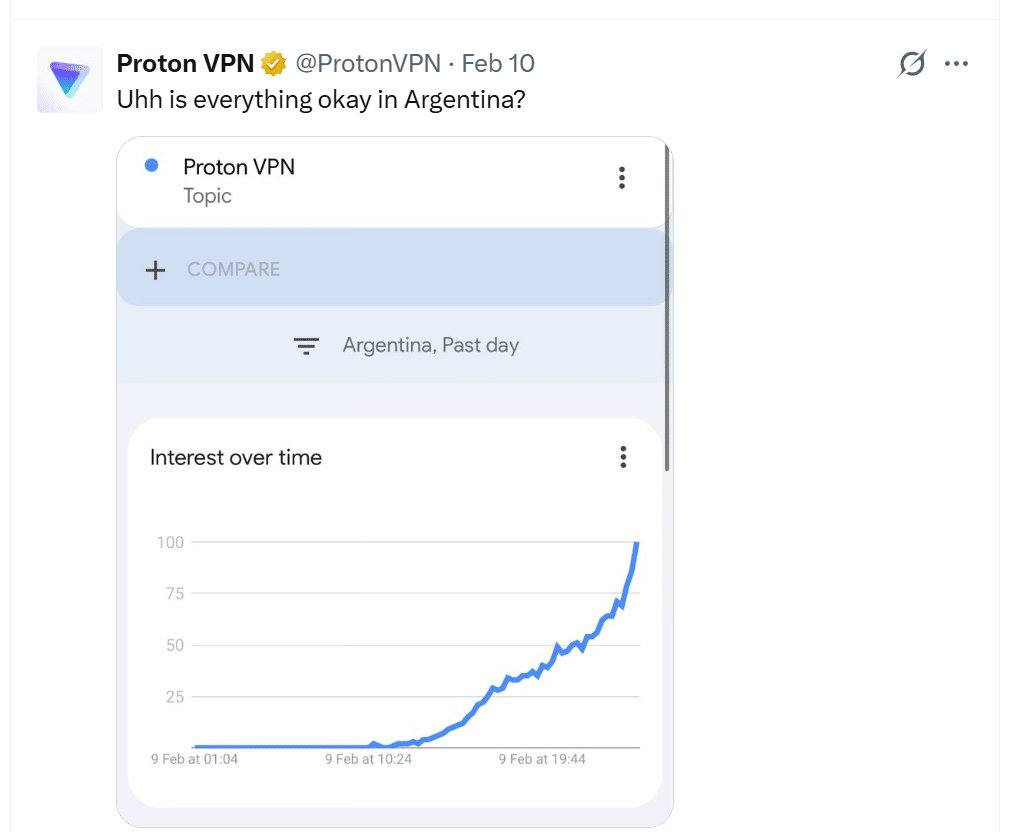
    Apparently, pirates quickly began sharing workarounds on social media. A common one involves installing ProtonVPN, connecting to a Mexican server, then reopening Magis TV or Xuper TV. In some cases, the apps work again via the VPN.

    Others are changing DNS settings on their smart TVs manually, though this is reportedly becoming less effective. According to FayerWayer, rights protection systems are now using AI to identify pirate IPTV traffic in real time, leaving users who reconnect with constant interruptions and degraded quality.

    What’s Next

    The search for workarounds in response to blocking efforts is not new. We have seen this countless times already, dating back more than a decade ago. It doesn’t only apply to users either; the operators of pirate services and apps also have to get creative.

    Whether Google actually complied with the removal order and, if so, what actions it took precisely remains an open question. Magis TV apps were distributed mostly as sideloaded APK files from third-party websites. For Google to remotely disable such an app, it would need to intervene on the users’ devices directly.

    App developers could likely find ways to work around it by rebranding again, simply continuing the game of whack-a-mole. But that’s nothing new, of course.

    From: TF , for the latest news on copyright battles, piracy and more.

    • chevron_right

      Facebook Rigorously Removes News Articles Mentioning Pirate Service “MagisTV”

      news.movim.eu / TorrentFreak • 28 July, 2025 • 2 minutes

    Similar to other social media platforms, Facebook has to battle a constant stream of copyrighted material, much of it posted by users who have no permission to do so.
    To facilitate this process, the company has rolled out several anti-piracy initiatives in recent years.

    Automated Piracy Takedowns

    For example, Facebook uses its “Rights Manager” tool to automatically detect infringing material and allow owners to take down or monetize the content. In addition, Facebook also uses third-party tools and in-house technology to address the problem.

    With these proactive tools, the social media giant hopes to help copyright holders protect their rights. At the same time, it also keeps the takedown notice volume low, which saves resources.

    While automated removal algorithms can work well, they are not infallible. This applies to keyword blacklists in particular, since on Facebook they appear to ban links to all content that simply mention forbidden words.

    Facebook Bans MagisTV Mentions

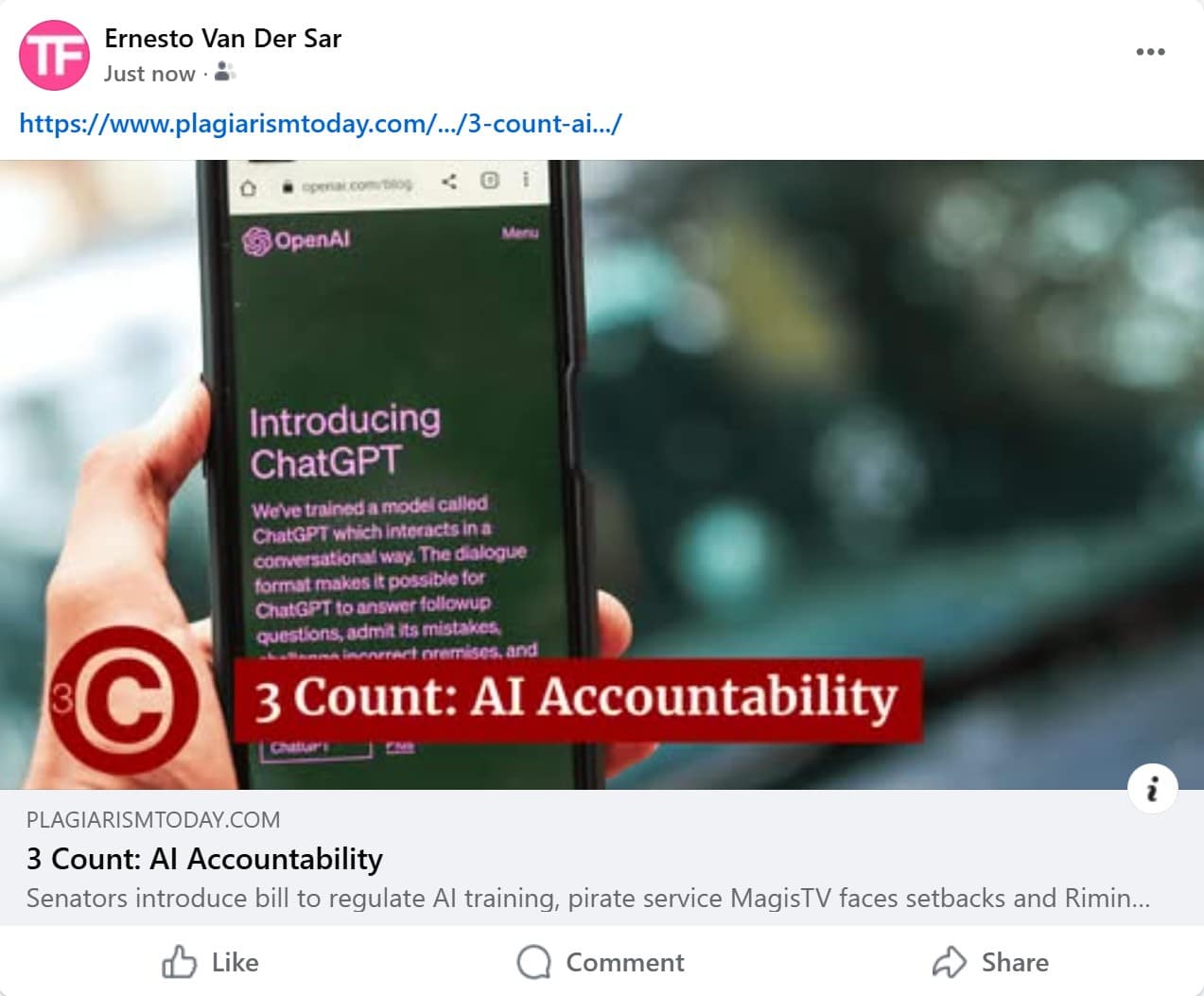
    A few days ago, Jonathan Bailey of Plagiarism Today informed us that Facebook flagged a post linking to one of his articles as potentially copyright infringing. The article in question is a news roundup that linked to a recent article we published on the popular piracy app MagisTV.

    Neither of the articles linked to any problematic material. On the contrary, it showed how the piracy app failed to secure a trademark while facing severe malware allegations.

    plagiarism

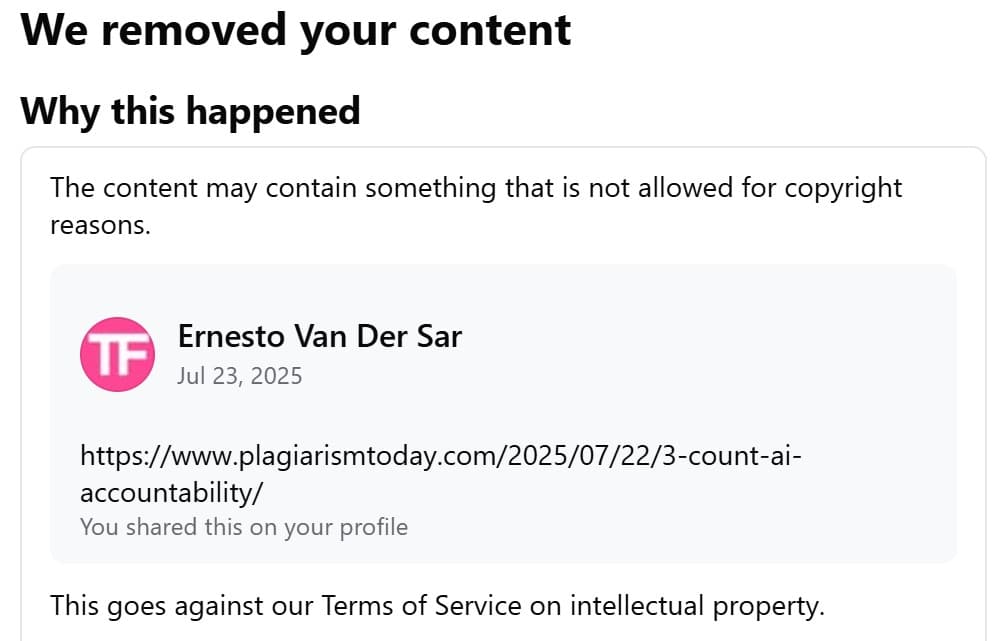
    To rule out the possibility this was some kind of outlier, we posted the Plagiarism Today article and the original TorrentFreak article on Facebook ourselves, which resulted in near-instant removals.

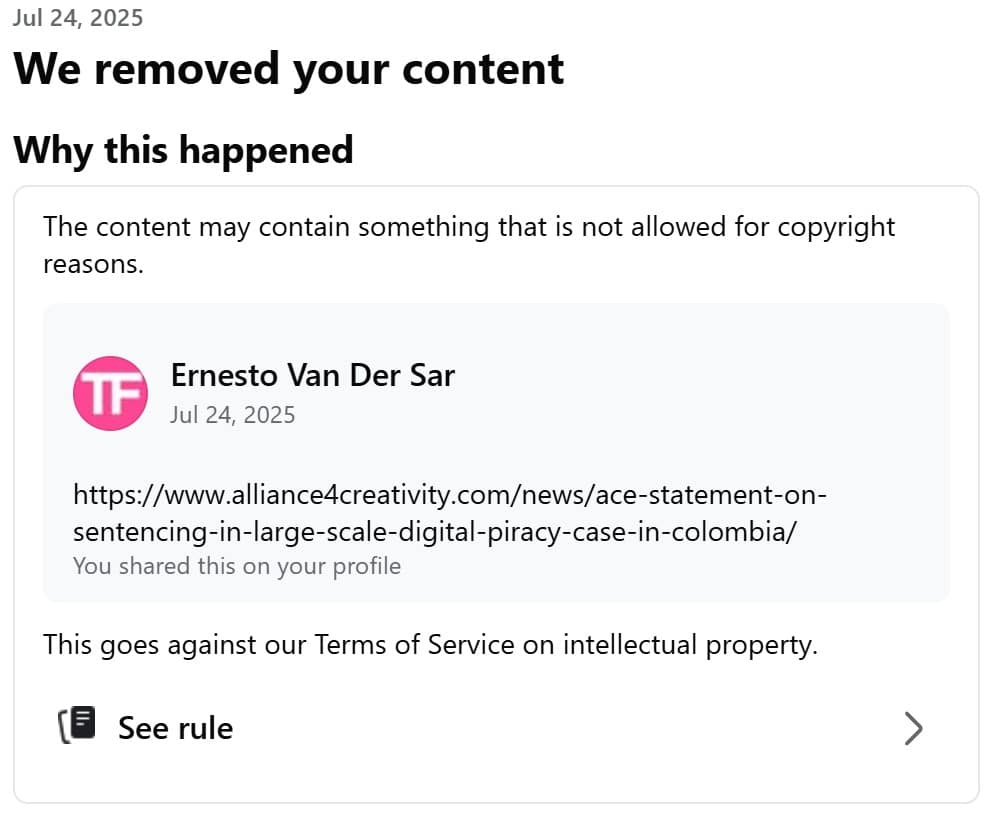
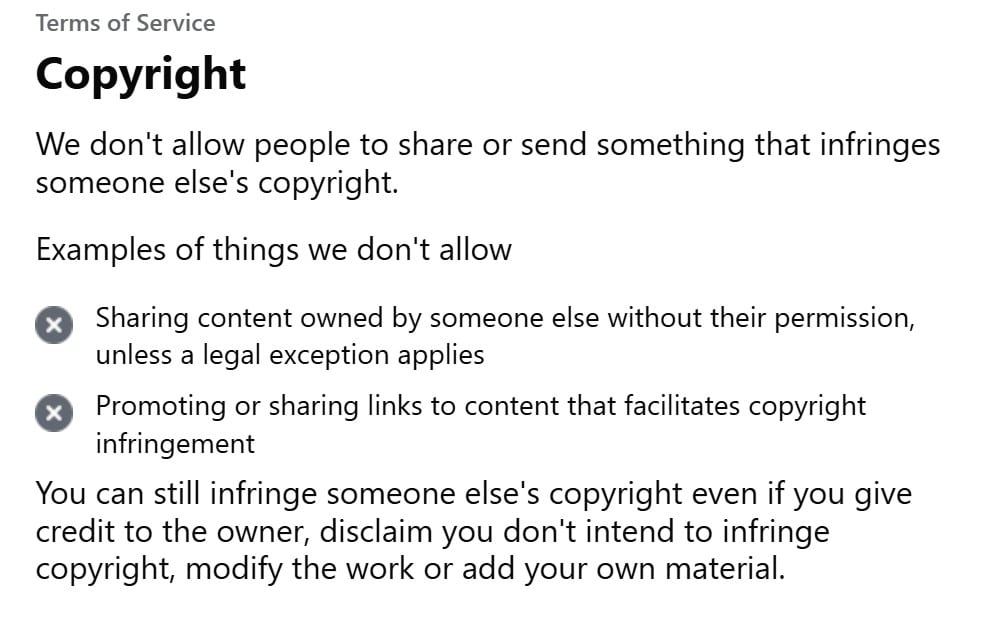
    “We removed your content,” Facebook writes in a short message, adding that “it may contain something that’s not allowed for copyright reasons,” which goes against its intellectual property Terms of Service.

    plagiarism-removed

    Facebook Removes News from Anti-Piracy Coalition ACE

    These tests suggest that Facebook has an issue with mere mentions of the term ‘MagisTV’. But would Facebook flag news articles authored by the Alliance for Creativity and Entertainment, a global anti-piracy coalition under the Motion Picture Association, that continuously works to shut MagisTV down?

    This question was swiftly answered when we posted an ACE press release mentioning MagisTV convictions on Facebook. Just a few minutes after it was published, the post was removed for copyright reasons.

    ace

    Apparently, simply mentioning MagisTV is a violation of Facebook’s Terms of Service. This is clearly an automated removal error, as none of the links or articles violate Facebook’s terms.

    facebook copyright

    Banned for Posting News

    Facebook’s automated removal rules are obviously not working perfectly. However, the platform allows affected accounts to appeal decisions, which is exactly what we did when the first post was removed last Wednesday.

    After five days, we still hadn’t heard back, so we decided to post a more recent article on MagisTV raids and arrests to see if these errors persist. And indeed they did; the article was swiftly taken down again.

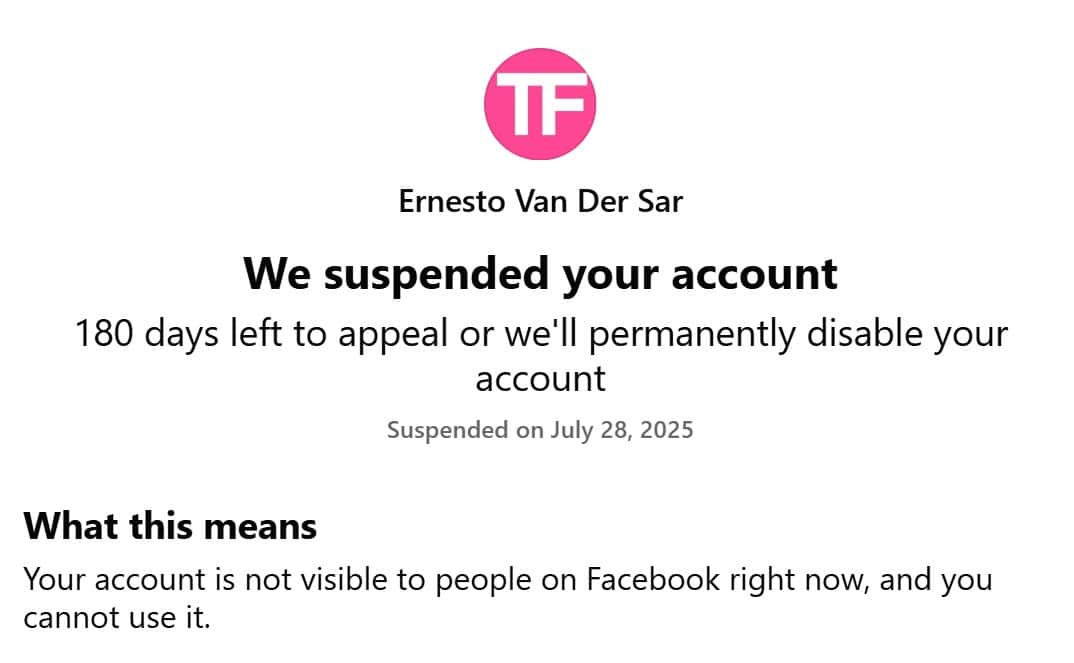
    In hindsight, that was a step too far, as the account we used was suspended with a threat to permanently disable it. We don’t feel the urgent need to appeal, but it’s not difficult to see how this could cause a lot of trouble for those heavily reliant on Facebook.

    suspended

    From: TF , for the latest news on copyright battles, piracy and more.

    • chevron_right

      Court Orders Google to “Uninstall” Pirate IPTV App Sideloaded on Android Devices

      news.movim.eu / TorrentFreak • 23 September, 2024 • 6 minutes

    google-magistv-s As reported last week, an order published in Argentina dated September 13, 2024, revealed that local ISPs are now required to block dozens of Magis TV-linked domains for violating intellectual property law.

    In total, 69 domains (full list in our earlier report ) must be blocked so that internet users cannot access them from anywhere inside Argentinian territory. The nature of the listed domains suggests that rightsholders focused on resellers of Magis TV subscriptions. One of the service’s main domains appears in the list but as things stand, any damage to availability is likely to be both limited and short-lived.

    Linked to Operation 404

    Our report coincided with the latest wave of Operation 404 in Brazil last Thursday, which also led to three arrests in Argentina. On Friday, dozens of local media reports linked those arrests to Magis TV.

    According to reports, Hugo Javier Mospan, 47, of Buenos Aires, is linked to the teaching of computer courses in Argentina. Before that he was an employee at a transport company.

    Leopoldo Federico Peña, 46, also of Buenos Aires, reportedly has a history of marketing household appliances and electronic equipment. In mid-2022, in concert with others, he reportedly registered several companies for the purposes of importing, exporting, distributing and maintaining such products.

    Leopoldo Peña, Kevin Bentancur and Hugo Mospan magis-arrested

    Infobae reports that the youngest of those arrested, 27-year-old Kevin Ariel Bentancur from Buenos Aires, had a job working at a car dealership. Pictures of all three were widely published by local media late last week following their arrests.

    News reports also showed law enforcement entering premises and retail outlets suspected of selling ‘fully-loaded’ TV boxes, with at least some devices sold with the Magis TV app pre-installed. A raid targeting ‘TodoTech’ in Misiones is said to have yielded just three TV boxes but another at “Kive” in CABA, a more impressive 481 TV boxes were seized by police.

    Source: YouTube magis-tv-raid-argentina

    Two other suspects, Roberto V. and Marcos DJ, are described as the most visible ‘marketers’ of Magis TV devices in Argentina. They’re still at large, according to reports, and somewhat less visible, at least for now.

    This type of high-profile action is clearly meant to send a message. Whether that message will include custodial sentences will remain to be seen, but the loss of money invested in devices taken away by the police has the potential to sting and give pause for thought, if nothing else.

    Yet whatever happens in Argentina, the court order has a component that goes beyond seizing devices and ISPs blocking Magis TV. The component isn’t just controversial; depending on how it’s handled, it could reverberate far beyond Argentina.

    If those who requested this additional component thought it through (there are clear signs that’s exactly what they did), whatever happens next will determine just how far rightsholders are prepared to go to ensure that people stop pirating live TV content.

    No Red Lines in This War

    The action targeting Magis TV appears to have two tracks, the blocking action and a criminal investigation. The initial complaint to the authorities was filed by LATAM anti-piracy group Alianza , which represents companies in, or connected to, the pay TV sector; Direct TV, Sky Brasil, Warner Bros. Discovery, Disney, Globo, Win Sports, Telecine, the list goes on.

    The investigation was carried out by Argentina’s Specialized Unit on Cybercrime ( UFEIC ) and headed by prosecutor Alejandro Musso. As we know, the request to block 69 Magis TV-linked domains was handed down on September 13 by Judge Esteban Rossignoli at Court 4 of San Isidro.

    No stranger to controversy himself, Judge Rossignoli granted a request that seems likely to be the source of even more. Prosecutor Musso says that the blocking of 69 domains means that the “app will no longer be able to be downloaded” but they needed to go much further than that. Specifically, the threat posed by millions of copies of Magis TV already installed on users’ devices needed to be eliminated. The Judge agreed.

    Google Ordered to Remotely Uninstall Magis TV From Users’ Devices

    In instructions to Google, Judge Rossignoli says that the company must “adopt the necessary technical means to immediately uninstall from Android systems that report IP addresses in the territory of the Argentine Republic (which can be verified by the IP addresses assigned to this country), the application named Magis TV.”

    The order specifies a filename (magis_mobile_v6.5.2.apk) and the following hash values:

    • SHA1: e68156b531ffaade1090b7326b7ae7d604975cd0
    • MD5: c4614c08c3be4ee9972870056d47afae

    A VirusTotal report confirms that both hashes relate to the same file, a 48.89 MB (51262825 bytes) Android APK.

    Two hashes, same file magis-tv-hashes

    Commenting on the instructions to Google, Musso acknowledges that “this has never been done before” but defends the unprecedented measure as entirely necessary.

    “What was achieved is an unprecedented court order, which is in the process of being analyzed by Google – we understand that they cannot deny it – which is to uninstall, through the Android operating system update, the application on all devices that have an IP address in Argentina,” Musso says.

    Measure Will be Replicated “Immediately”

    Having been granted this type of power once, rightsholders aren’t known for letting the momentum go to waste. In recent years, as anti-piracy efforts have become more globalized, court orders issued in one country are often cited in others, showcasing the potential power courts possess if they truly prioritize intellectual property protection. In Argentina, this expansion appears to have been part of the planning.

    “We understand that this measure will be replicated immediately by many countries that have this same type of problem,” Prosecutor Musso continues.

    “What will be achieved once this is completed is that the installed app disappears and cannot be downloaded again, thus breaking the cycle of digital piracy. The only way [Magis TV] could circumvent this is to develop a new app where we would be waiting for them, ready to do exactly the same thing once we identify it.”

    For Alianza member LaLiga, this development couldn’t have come soon enough. Spain’s top-tier football league has been campaigning for apps to be remotely deleted from Android devices for some time, including last September when it claimed to be discussing the measure with Google .

    “This ruling by the Argentine authorities following prosecutor Musso’s investigation, based on the evidence presented by Alianza, represents a global example in the fight against piracy and theft of audiovisual content,” says LaLiga President Javier Tebas.

    “Not only have all the domains associated with the illegal service and its technological infrastructure been blocked, but it has also been ruled that Google must prevent the use of illegal applications already installed on Android devices through its security mechanisms, something we have requested on numerous occasions. In fact, a judge of first instance in Spain already issued an order in 2022 calling for a similar measure from Google at the request of LaLiga, in a process that’s still ongoing.”

    Google Yet To Respond In Public

    Rightsholders appear to have no red lines in their fight against piracy, but for Google this looks like a minefield requiring the most delicate of steps to protect the global Android brand. While users are unlikely to appreciate Google reaching into their devices to disable software downloaded and installed using Google Play, the idea that third party apps installed independently could be eliminated remotely is an issue for every Android user.

    Whether Google will challenge the ruling head on or look for another reason to justify the deletion, is currently unknown. The implications are unknown too, but it may not be too long before Android users start to find out.

    From: TF , for the latest news on copyright battles, piracy and more.