

call_end

    • chevron_right

      Critics slam OpenAI’s parental controls while users rage, “Treat us like adults”

      news.movim.eu / ArsTechnica • 30 September
    As OpenAI tells it, the company has been consistently rolling out safety updates ever since parents, Matthew and Maria Raine, sued OpenAI, alleging that "ChatGPT killed my son."

    On August 26, the day that the lawsuit was filed, OpenAI seemed to publicly respond to claims that ChatGPT acted as a "suicide coach" for 16-year-old Adam Raine by posting a blog promising to do better to help people "when they need it most."

    By September 2, that meant routing all users' sensitive conversations to a reasoning model with stricter safeguards, sparking backlash from users who feel like ChatGPT is handling their prompts with kid gloves. Two weeks later, OpenAI announced it would start predicting users' ages to improve safety more broadly. Then, this week, OpenAI introduced parental controls for ChatGPT and its video generator Sora 2. Those controls allow parents to limit their teens' use and even get access to information about chat logs in "rare cases" where OpenAI's "system and trained reviewers detect possible signs of serious safety risk."
    Read full article

    Comments

    • chevron_right

      Researchers find a carbon-rich moon-forming disk around giant exoplanet

      news.movim.eu / ArsTechnica • 30 September • 1 minute

    Many of the most interesting bodies in our Solar System aren't planets, but the moons that orbit them. They have active volcanoes, hydrocarbon oceans, geysers, and moon-wide oceans buried under icy crusts. And, as far as we can tell, the physics of the processes that produce large planets should make moon formation inevitable. Given how common planets are, our galaxy should be teeming with moons.

    Yet, despite some tantalizing hints, we've not found a clear indication of a moon orbiting an exoplanet. What we have found are a few very young exoplanets that appear to have moon-forming disks around them. Now, the James Webb Space Telescope has obtained a spectrum of the ring-forming disk around a giant super-Jupiter, and found that it's rich in small carbon-based molecules. That's despite the fact that the star it's orbiting seems to have a planet-forming disk that's mostly water.

    Finding disks

    We search for exo-moons and moon-forming disks using completely different methods. To spot an actual moon, we rely on its gravitational influence. At some points in its orbit, it will be towing its planet forward to speed up its orbit; at others, it will be holding its planet back. This introduces subtle variations in the timing of when the planet arrives in front of the star from Earth's perspective.

    Read full article

    Comments

    • chevron_right

      How “prebunking” can restore public trust and other September highlights

      news.movim.eu / ArsTechnica • 30 September

    It's a regrettable reality that there is never enough time to cover all the interesting scientific stories we come across each month. In the past, we've featured year-end roundups of cool science stories we (almost) missed. This year, we're experimenting with a monthly collection. September's list includes how prebunking can restore public trust in election results; why ghost sharks grow weird forehead teeth; and using neutrinos to make a frickin' laser beam, among other highlights.

    Prebunking increases trust in elections

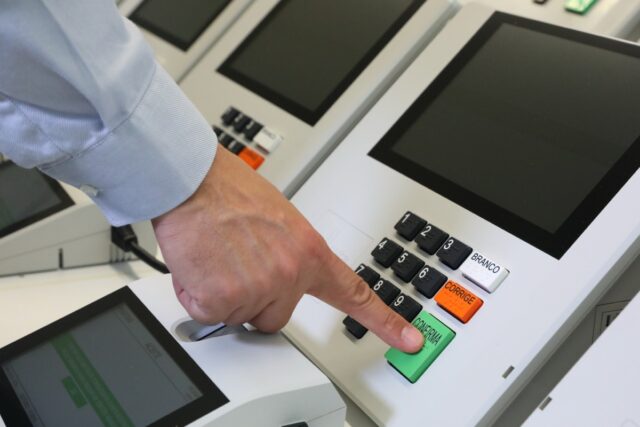
    Brazilian voting machine showing a man's hand pushing the submit button Credit: Superior Electoral Court of Brazil /Public domain

    False claims of voter fraud abounded in the wake of the 2020 US general election, when Joe Biden defeated incumbent Donald Trump for the presidency. Trump himself amplified those false claims, culminating in the violent attack on the US Capitol building on January 6, 2021. Two years later, Brazil faced a similar scenario in the wake of its 2022 general election in which voters ousted incumbent President Jair Bolsonaro. Once again, claims of fraud ran rampant as Bolsonaro supporters stormed their country's capital.

    Read full article

    Comments

    • chevron_right

      Intel and AMD trusted enclaves, the backbone of network security, fall to physical attacks

      news.movim.eu / ArsTechnica • 30 September • 1 minute

    In the age of cloud computing, protections baked into chips from Intel, AMD, and others are essential for ensuring confidential data and sensitive operations can’t be viewed or manipulated by attackers who manage to compromise servers running inside a data center. In many cases, these protections—which work by storing certain data and processes inside encrypted enclaves known as TEEs ( Trusted Execution Enclaves )—are essential for safeguarding secrets stored in the cloud by the likes of Signal Messenger and WhatsApp . All major cloud providers recommend that customers use it. Intel calls its protection SGX , and AMD has named it SEV-SNP .

    Over the years, researchers have repeatedly broken the security and privacy promises that Intel and AMD have made about their respective protections. On Tuesday, researchers independently published two papers laying out separate attacks that further demonstrate the limitations of SGX and SEV-SNP. One attack, dubbed Battering RAM, defeats both protections and allows attackers to not only view encrypted data but also to actively manipulate it to introduce software backdoors or to corrupt data. A separate attack known as Wiretap is able to passively decrypt sensitive data protected by SGX and remain invisible at all times.

    Attacking deterministic encryption

    Both attacks use a small piece of hardware, known as an interposer, that sits between CPU silicon and the memory module. Its position allows the interposer to observe data as it passes from one to the other. They exploit both Intel’s and AMD’s use of deterministic encryption , which produces the same ciphertext each time the same plaintext is encrypted with a given key. In SGX and SEV-SNP, that means the same plaintext written to the same memory address always produces the same ciphertext.

    Read full article

    Comments

    • chevron_right

      DeepSeek tests “sparse attention” to slash AI processing costs

      news.movim.eu / ArsTechnica • 30 September • 1 minute

    Ever wonder why ChatGPT slows down during long conversations? The culprit is a fundamental mathematical challenge: processing long sequences of text requires massive computational resources, even with the efficiency tricks that companies have already deployed. While US tech giants can afford to throw more hardware at the problem, Chinese AI company DeepSeek , which is cut off from a steady supply of some advanced AI chips by export restrictions , has extra motivation to squeeze more performance from less silicon.

    On Monday, DeepSeek released an experimental version of its latest simulated reasoning language model, DeepSeek-V3.2-Exp, which introduces what it calls "DeepSeek Sparse Attention" (DSA). It's the company's implementation of a computational technique likely already used in some of the world's most prominent AI models. OpenAI pioneered sparse transformers in 2019 and used the technique to build GPT-3, while Google Research published work on " Reformer " models using similar concepts in 2020. (The full extent to which Western AI companies currently use sparse attention in their latest models remains undisclosed.)

    Despite sparse attention being a known approach for years, DeepSeek claims its version achieves "fine-grained sparse attention for the first time" and has cut API prices by 50 percent to demonstrate the efficiency gains. But to understand more about what makes DeepSeek v3.2 notable, it's useful to refresh yourself on a little AI history.

    Read full article

    Comments

    • chevron_right

      After threatening ABC over Kimmel, FCC chair may eliminate TV ownership caps

      news.movim.eu / ArsTechnica • 30 September

    Fresh off his crusade against Jimmy Kimmel and ABC, the chair of the Federal Communications Commission may eliminate TV station ownership limits in a potential gift for station owners like Sinclair and Nexstar.

    When FCC Chairman Brendan Carr threatened ABC affiliates with license revocations for carrying Jimmy Kimmel's show, he said that national networks exert too much control over local TV stations and that he's trying "to empower local TV stations to serve the needs of the local communities." Taking a cue from Carr, Sinclair and Nexstar continued blocking Jimmy Kimmel Live! on their ABC affiliates even after ABC and its owner Disney ended Kimmel's suspension.

    Within days, Sinclair and Nexstar decided to put Kimmel back on the air . Pressure from viewers and advertisers likely played a major role in the reversal. But for Carr, the episode might reinforce his belief that station groups should have more influence over national programming.

    Read full article

    Comments

    • chevron_right

      With new agent mode for Excel and Word, Microsoft touts “vibe working”

      news.movim.eu / ArsTechnica • 30 September

    With a new set of Microsoft 365 features , knowledge workers will be able to generate complex Word documents or Excel spreadsheets using only text prompts to Microsoft's chat bot. Two distinct products were announced, each using different models and accessed from within different tools—though the similar names Microsoft chose make it confusing to parse what's what.

    Driven by OpenAI's GPT-5 large language model, Agent Mode is built into Word and Excel, and it allows the creation of complex documents and spreadsheets from user prompts. It's called "agent" mode because it doesn't just work from the prompt in a single step; rather, it plans multi-step work and runs a validation loop in the hopes of ensuring quality.

    It's only available in the web versions of Word and Excel at present, but the plan is to bring it to native desktop applications later.

    Read full article

    Comments

    • chevron_right

      YouTuber unboxes what seems to be a pre-release version of an M5 iPad Pro

      news.movim.eu / ArsTechnica • 30 September • 1 minute

    Apple's biggest product event of the year happens in September, when the company puts out a new batch of iPhones and Apple Watches and other odds and ends. But in most years, Apple either has another smaller event or just a handful of additional product announcements later in the fall in October or November—usually the focus is on the Mac, the iPad, or both.

    It seems like a new iPad Pro could be one of the announcements on tap. Russian YouTube channel Wylsacom has posted an unboxing video and early tour of what appears to be a retail boxed version of a new 256GB 13-inch iPad Pro, as well as an M5 processor that we haven't seen in any other Apple product yet. This would be the first new iPad Pro since May of 2024, when Apple introduced the current M4 version .

    The same channel also got ahold of the M4 MacBook Pro early , so it seems likely that this is genuine. And while the video is mostly dedicated to complaining about packaging, the wattage of the included power adapter, and how boring it is that Apple doesn't introduce dramatic design changes every generation, it does also give us some early performance numbers for the new M5.

    Read full article

    Comments

    • chevron_right

      SpaceX has a few tricks up its sleeve for the last Starship flight of the year

      news.movim.eu / ArsTechnica • 30 September

    On its surface, the flight plan for SpaceX's next Starship flight looks a lot like the last one.

    The rocket's Super Heavy booster will again splash down in the Gulf of Mexico just offshore from SpaceX's launch site in South Texas. And Starship, the rocket's upper stage, will fly on a suborbital arc before reentering the atmosphere over the Indian Ocean for a water landing northwest of Australia.

    SpaceX will again test the rocket's satellite deployer and reignite one of the ship's Raptor engines in space to adjust the vehicle's path for reentry. These demonstrations will pave the way for future Starship flights into low-Earth orbit. All of the rocket's ascents to date have, by design, ended before reaching orbital velocity.

    Read full article

    Comments