call_end

    • chevron_right

      Driverless cars are coming to the UK – but the road to autonomy has bumps ahead

      news.movim.eu / TheGuardian • 18 October, 2025

    Waymo plans London robotaxis as early as 2026, but the history shows hype, hesitation and a few missed turns

    The age-old question from the back of the car feels just as pertinent as a new era of autonomy threatens to dawn: are we nearly there yet? For Britons, long-promised fully driverless cars, the answer is as ever – yes, nearly. But not quite.

    A landmark moment on the journey to autonomous driving is, again, just around the corner. This week, Waymo, which successfully runs robotaxis in San Francisco and four other US cities, announced it was bringing its cars to London .

    Continue reading...
    • chevron_right

      BitTorrent’s DHT and the Leading ISP Networks Helping to Keep it Alive

      news.movim.eu / TorrentFreak • 27 September, 2025 • 5 minutes

    dht-2-s Nearly a quarter of a century after its debut, internet users stocking up on the latest multi-GB Linux distros can still do so with help from the BitTorrent protocol.

    Able to download chunks of even the largest files, distributed among other users who could be anywhere on the planet, BitTorrent’s file transfer skills are two decades old yet never fail to impress.

    For those yet to sample the magic of magnet links, the whole process begins with a humble .torrent file. These relatively small files contain metadata relating to the large file the user wants to download, including the location of one or more ‘trackers’, the central online servers that facilitate communication between users’ torrent clients.

    Yet the real magic lies in BitTorrent’s resilience; it has a secret weapon that can find those chunks of data, wherever they may be, even when central trackers are blocked or shut down. It’s called DHT – Distributed Hash Table – and it’s one of the key reasons BitTorrent still performs so well on the global stage, even today.

    Trackers Are Useful But Disposable

    A central server known as a tracker communicates with torrent clients to coordinate transfers of files between them. When a client requests a piece of a file the tracker knows is available, the tracker tells the client which other clients have it and from there, transfers take place peer-to-peer. Periodically, clients update the tracker with new information about the network, and so the cycle continues.

    DHT, on the other hand, empowers torrent clients with the ability to receive and impart information directly with other clients. By creating distributed network knowledge, there’s no absolute need for a tracker, eliminating a potential central point of failure.

    Peers knowledge of other peers is boosted by Peer Exchange or PEX , a system through which a client that’s connected to another client, shares the IP addresses of peers it already knows. This increases the recipient client’s pool of connectivity opportunities and, if all goes well, speeds up downloads.

    bittorrent-network When new clients join the DHT, other torrent clients share content locations with the newcomer and, given time, the client returns the favor by passing information to other clients following similar requests.

    The process is boosted locally using PEX, but the aim is the same – discovery of other clients/peers to create a more robust network with more effective file transfers.

    In short, DHT makes every client a node in a vast decentralized network, with each sharing their growing knowledge of the network with other clients, that in turn have knowledge they’ll automatically share with others.

    No single client knows the location of everything and even the pooled knowledge of thousands is unlikely to produce a full network map. However, most clients know enough to point out the location of at least something useful, and with PEX, they’ll provide the locations of other clients which helps to strengthen the overall network.

    To many people the sharing of content is the most visible aspect of BitTorrent, but its real strength lies in the sharing of information that maintains the underlying network. The network that underlies that obviously plays a massive role too.

    Tens of Millions of Peers But Hard to Measure

    In the bigger picture, the loss of few clients from public DHT is a non-event. Indeed, the sudden shut down of a major residential internet provider somewhere in the world may not be especially disruptive either, given the scale of the network. Yet putting an exact figure on the size of the network has to date proven elusive.

    The lowest estimates always start in the millions of peers, with some researchers previously reporting anything from 20 to 30 million, sometimes a few million more, other times a few million less.

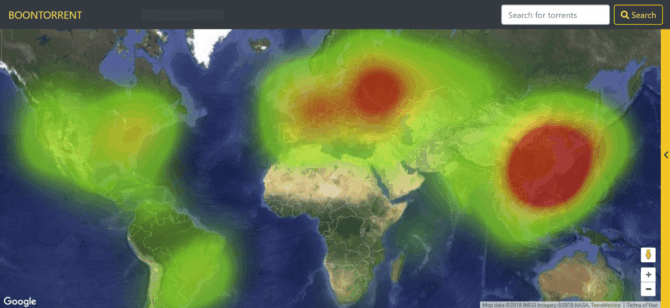
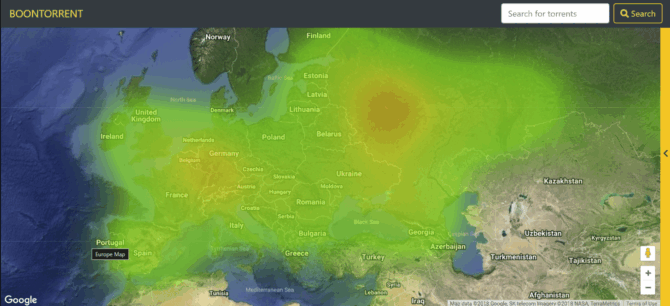
    Researchers behind BoonTorrent , a now seven-year-old project to create a real-time monitoring tool for BitTorrent DHT traffic, reported that “BitTorrent traffic is abundant, but difficult to analyze. To capture enough data for significant analysis, a large distributed solution is needed.”

    Their solution included a heatmap visualization of the previous two minutes of traffic, with two examples shown below.

    BoonTorrent DHT Heatmap 1 boontorrent-eu
    BoonTorrent DHT Heatmap 2 boontorrent-asia-rus

    Depending on the circumstances, we know that the number of peers can vary by at least 10 million, possibly more at times, or less.

    That being said, these images suggest that Southeast Asia and Russia had quite the presence on BitTorrent’s DHT seven years ago. That’s a long time in internet years and everything is subject to change.

    Some ISPs Play Big Roles Supporting DHT Worldwide

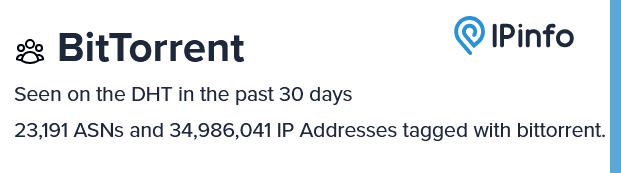
    As far as we’re aware, there are no large, recent studies on BitTorrent’s DHT so the overall numbers remain as elusive as ever. However, when using the tools available at IPinfo.io , something unexpected appeared; tracking data for BitTorrent’s DHT and some estimates based on IPinfo’s visibility of the network.

    ipinfo-dht

    The data displayed as of today concerns the number of IP addresses and their corresponding ASNs observed on the Mainline DHT in the past 30 days. The data obtained by TF from IPinfo.io just a few days ago is broadly the same.

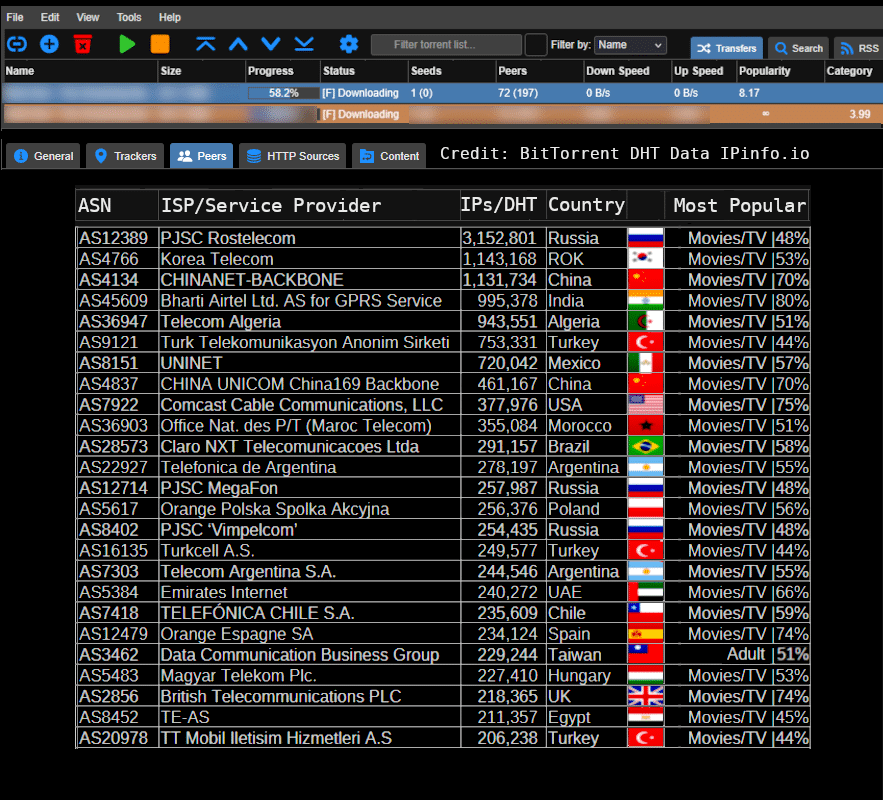
    When drilling down into the details, the data provides an overview of the ISPs with the greatest number of allocated IP addresses observed on the DHT network.

    Top ISPs With a Strong Customer DHT Presence

    With 3,152,801 IP addresses observed on the DHT during the previous 30 days, Russian ISP PJSC Rostelecom comfortably takes the top spot. Lagging two million IP addresses behind, Korea Telecom takes second place (1,143,168 IPs) with CHINANET-BACKBONE narrowly behind with 1,131,734 observed IPs.

    Positioned between ISPs from China and Morocco, Comcast Cable Communications takes 9th place with 377,976 observed IP addresses, with the UK’s British Telecommunications PLC edging out competition from Egypt and Turkey with 218,365 IP addresses. Given the site-blocking measures in place at BT, that’s a considerable number of subscribers sharing content openly, with no apparent need for a VPN.

    The full list is available below, with a bonus column of most popular content downloaded by users in each country, tracked by IKnowWhatYouDownloaded on the DHT itself. Ultimately, the data provides a clear snapshot of BitTorrent’s modern landscape and the international telecom giants its users connect from.

    It’s worth noting that a) this view of the DHT may not be complete and b) countries without a dominant national ISP may have many smaller ISPs not covered in the report. Even with that caveat, pushing Russia from the top spot overall seems unlikely since it already appears three times in the same table.

    ipinfo-torrents6

    From: TF , for the latest news on copyright battles, piracy and more.

    • chevron_right

      Adviser to UK minister claimed AI firms will never have to compensate creatives

      news.movim.eu / TheGuardian • 24 September, 2025

    Exclusive: Kirsty Innes made statement in now-deleted post on X seven months before taking up role as Liz Kendall aide

    A senior ministerial aide said AI companies will never have to compensate creatives for using their content to train their systems, in a statement that has alarmed campaigners demanding Labour delivers a fairer deal for musicians, artists and writers from the tech industry.

    Kirsty Innes, recently appointed as a special adviser to Liz Kendall, the secretary of state for science, innovation and technology, said “whether or not you philosophically believe the big AI firms should compensate content creators, they in practice will never legally have to”.

    Continue reading...
    • chevron_right

      UK’s YouTube and TikTok content creators deserve more rights, say MPs

      news.movim.eu / TheGuardian • 24 September, 2025

    Cross-party group to ‘tear down barriers that stifle talent’, from mortgage difficulties to filming permit problems

    A new cross-party group of MPs and peers is demanding more rights for Britain’s growing army of online content creators, amid concerns they face obstacles in securing everything from basic equipment to mortgages.

    The rise of content creators on YouTube and TikTok has transformed the media world, with individual streamers each attracting millions of subscribers to their channels. New research has suggested they are worth £2.2bn to the economy.

    Continue reading...
    • chevron_right

      US border patrol collected DNA from thousands of US citizens for years, data shows

      news.movim.eu / TheGuardian • 23 September, 2025

    CBP officers took DNA samples from about 2,000 citizens, some as young as 14 and many who never faced criminal charges, new analysis shows

    In March 2021, a 25-year-old US citizen was traveling through Chicago’s Midway airport when they were stopped by US border patrol agents. Though charged with no crime, the 25-year-old was subjected to a cheek swab to collect their DNA, which was sent to the FBI, according to a new report. The unnamed citizen was later admitted into the country. Their DNA was added to the FBI’s database of genetic material despite the lack of criminal charges.

    The 25-year-old is one of about 2,000 US citizens whose DNA was collected between 2020 and 2024 by the Department of Homeland Security and shared with the FBI, researchers from Georgetown’s Center on Privacy and Technology found in an analysis of recently released data from US Customs and Border Protection (CBP). CBP officers took genetic material from some citizens as young as 14, according to the report.

    Continue reading...
    • chevron_right

      ‘Tentacles squelching wetly’: the human subtitle writers under threat from AI

      news.movim.eu / TheGuardian • 23 September, 2025

    Artificial intelligence is making steady advances into subtitling but, say its practitioners, it’s a vital service that needs a human to make it work

    Is artificial intelligence going to destroy the SDH [subtitles for the deaf and hard of hearing] industry? It’s a valid question because, while SDH is the default subtitle format on most platforms, the humans behind it – as with all creative industries – are being increasingly devalued in the age of AI. “SDH is an art, and people in the industry have no idea. They think it’s just a transcription,” says Max Deryagin, chair of Subtle, a non-profit association of freelance subtitlers and translators.

    The thinking is that AI should simplify the process of creating subtitles, but that is way off the mark, says Subtle committee member Meredith Cannella. “There’s an assumption that we now have to do less work because of AI tools. But I’ve been doing this now for about 14-15 years, and there hasn’t been much of a difference in how long it takes me to complete projects over the last five or six years.”

    Continue reading...
    • chevron_right

      ‘It’s prime time for rapture talk’: TikTok gets its first ‘world is ending’ moment

      news.movim.eu / TheGuardian • 23 September, 2025

    Evangelical Christians on #RaptureTok are warning others of doom on 23 or 24 September – and sharing how they’re prepping

    If you believe a vocal cohort of evangelical Christians on social media, consider Tuesday 23 September – or maybe Wednesday 24 September – a wrap on this whole society thing. For the first time, the rapture is playing out on TikTok .

    Believers have taken to the app to disclose their preparation for impending doom, claiming to have sold their cars or requested “ eternity leave ” from their employers, and fretting over whether the family dog gets to come to heaven too. One woman advised her followers to do away with their phones’ password protections, so that any loved ones that get left behind can easily access their personal information. Another bought Bibles in bulk at Dollar Tree, which she planned to leave behind with personalized notes in hopes of saving some last-minute converts.

    Continue reading...
    • chevron_right

      UK teachers and parents: what is the impact of deepfakes in your school?

      news.movim.eu / TheGuardian • 23 September, 2025

    We’d like to hear from schools and parents across the UK about how they are responding to AI generated deepfakes among pupils, and how it is impacting on children and school communities

    There have been a growing number of reports of AI generated deepfake images or videos being used maliciously against pupils and teachers.

    One of the first cases to hit the headlines was in Spain where 15 schoolchildren were sentenced to a year’s probation last year for creating and spreading AI generated images of their female peers.

    Continue reading...
    • chevron_right

      Pixel 10 Pro XL review: Google’s superphone gets AI and magnetic upgrades

      news.movim.eu / TheGuardian • 23 September, 2025

    Top camera, great software, solid battery life and huge screen bolstered by helpful Gemini and Qi2 support

    Google’s Pixel superphone is back, packed with a bigger battery, faster charging, magnetic accessories and even more cutting-edge AI tools to try to usurp Apple and Samsung as the monarchs of really big phones.

    The Pixel 10 Pro XL is the largest slab phone Google makes and is one of the biggest available in Europe and the US. It costs £1,199 (€1,299/$1,199/A$1,999), sitting above its smaller sibling the Pixel 10 Pro and below the upcoming folding Pixel 10 Pro Fold, and competing directly with Apple’s iPhone 17 Pro Max and Samsung’s Galaxy S25 Ultra .

    Continue reading...