
call_end

    • chevron_right

      First revealed in spy photos, a Bronze Age city emerges from the steppe

      news.movim.eu / ArsTechnica • 21 November, 2025 • 1 minute

    Today all that’s left of the ancient city of Semiyarka are a few low earthen mounds and some scattered artifacts, nearly hidden beneath the waving grasses of the Kazakh Steppe, a vast swath of grassland that stretches across northern Kazakhstan and into Russia. But recent surveys and excavations reveal that 3,500 years ago, this empty plain was a bustling city with a thriving metalworking industry, where nomadic herders and traders might have mingled with settled metalworkers and merchants.
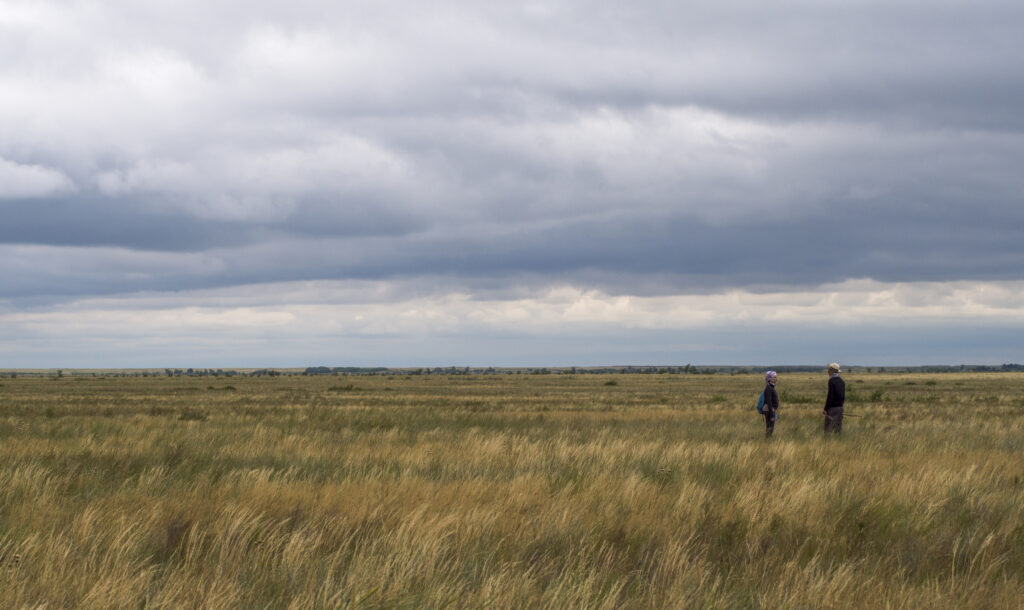
    Photo of two people standing on a grassy plain under a gray sky Radivojevic and Lawrence stand on the site of Semiyarka. Credit: Peter J. Brown

    Welcome to the City of Seven Ravines

    University College of London archaeologist Miljana Radivojevic and her colleagues recently mapped the site with drones and geophysical surveys (like ground-penetrating radar, for example), tracing the layout of a 140-hectare city on the steppe in what’s now Kazakhstan.

    The Bronze Age city once boasted rows of houses built on earthworks, a large central building, and a neighborhood of workshops where artisans smelted and cast bronze. From its windswept promontory, it held a commanding view of a narrow point in the Irtysh River valley, a strategic location that may have offered the city “control over movement along the river and valley bottom,” according to Radivojevic and her colleagues. That view inspired archaeologists’ name for the city: Semiyarka, or City of Seven Ravines.

    Read full article

    Comments

    • chevron_right

      ‘There are many zoos I would like to see closed’: Zoo chief plans shake up

      news.movim.eu / TheGuardian • 21 November, 2025

    As debate continues to rage over the welfare of animals in captivity, David Field is hoping to drag the sector forward

    He has loved zoos all his life, but would close many of them down if he could.

    David Field, who this month became head of the world’s zoo industry group, said of zoos that treat animals badly: “It makes me feel desperate. I’ve probably in my life tried to close down more zoos than open them.”

    Continue reading...
    • chevron_right

      Rocket Report: SpaceX’s next-gen booster fails; Pegasus will fly again

      news.movim.eu / ArsTechnica • 21 November, 2025 • 1 minute

    Welcome to Edition 8.20 of the Rocket Report! For the second week in a row, Blue Origin dominated the headlines with news about its New Glenn rocket. After a stunning success November 13 with the launch and landing of the second New Glenn rocket, Jeff Bezos’ space company revealed a roadmap this week showing how engineers will supercharge the vehicle with more engines. Meanwhile, in South Texas, SpaceX took a step toward the first flight of the next-generation Starship rocket. There will be no Rocket Report next week due to the Thanksgiving holiday in the United States. We look forward to resuming delivery of all the news in space lift the first week of December.

    As always, we welcome reader submissions . If you don’t want to miss an issue, please subscribe using the box below (the form will not appear on AMP-enabled versions of the site). Each report will include information on small-, medium-, and heavy-lift rockets, as well as a quick look ahead at the next three launches on the calendar.

    Northrop’s Pegasus rocket wins a rare contract. A startup named Katalyst Space Technologies won a $30 million contract from NASA in August to build a robotic rescue mission for the agency’s Neil Gehrels Swift Observatory in low-Earth orbit. Swift, in space since 2004, is a unique instrument designed to study gamma-ray bursts, the most powerful explosions in the Universe. The spacecraft lacks a propulsion system and its orbit is subject to atmospheric drag, and NASA says it is “racing against the clock” to boost Swift’s orbit and extend its lifetime before it falls back to Earth. On Wednesday, Katalyst announced it selected Northrop Grumman’s air-launched Pegasus XL rocket to send the rescue craft into orbit next year.

    Read full article

    Comments

    • chevron_right

      Scientists found the key to accurate Maya eclipse tables

      news.movim.eu / ArsTechnica • 20 November, 2025 • 1 minute

    Astronomical events such as eclipses were central to Maya culture, reflected in the care the Maya took to keep accurate calendars to aid in celestial predictions. Among the few surviving Maya texts is the so-called Dresden Codex, which includes a table of eclipses. Researchers have concluded that this table was repurposed from earlier lunar month tables, rather than being created solely for eclipse prediction, according to a paper published in the journal Science Advances. They also figured out the mechanism by which the Maya ensured that table would be accurate over a very long time period.

    The Maya used three primary calendars: a count of days, known as the Long Count; a 260-day astrological calendar called the Tzolk’in; and a 356-day year called the Haab’. Previous scholars have speculated on how awe-inspiring solar or lunar eclipses must have seemed to the Maya, but our understanding of their astronomical knowledge is limited. Most Maya books were burned by Spanish conquistadors and Catholic priests. Only four hieroglyphic codices survive: the Dresden Codex, the Madrid Codex, the Paris Codex, and the Grolier Codex.

    The Dresden Codex dates back to the 11th or 12th century and likely originated near Chichen Itza. It can be folded accordion-style and is 12 feet long in its unfolded state. The text was deciphered in the early 20th century and describes local history as well as astronomical lunar and Venus tables.

    Read full article

    Comments

    • chevron_right

      Flying with whales: Drones are remaking marine mammal research

      news.movim.eu / ArsTechnica • 20 November, 2025

    In 2010, the Deepwater Horizon oil rig exploded in the Gulf of Mexico, causing one of the largest marine oil spills ever. In the aftermath of the disaster, whale scientist Iain Kerr traveled to the area to study how the spill had affected sperm whales, aiming specialized darts at the animals to collect pencil eraser-sized tissue samples.

    It wasn’t going well. Each time his boat approached a whale surfacing for air, the animal vanished beneath the waves before he could reach it. “I felt like I was playing Whac-A-Mole,” he says.

    As darkness fell, a whale dove in front of Kerr and covered him in whale snot. That unpleasant experience gave Kerr, who works at the conservation group Ocean Alliance , an idea: What if he could collect that same snot by somehow flying over the whale? Researchers can glean much information from whale snot, including the animal’s DNA sequence, its sex, whether it is pregnant, and the makeup of its microbiome.

    Read full article

    Comments

    • chevron_right

      Moss in space: spores survive nine-month ride on outside of ISS

      news.movim.eu / TheGuardian • 20 November, 2025

    Scientists say plant’s resilience suggests it could help with oxygen generation or soil formation on space missions

    Matt Damon grew potatoes for survival in The Martian, but researchers say mosses could one day help turn the dust and rocks of other planets into fertile soil.

    Physcomitrella patens , or spreading earthmoss, is already known as a pioneering species – albeit for being an early plant on the scene in areas of barren mud. Now researchers have found that spores of the moss can survive for at least nine months stuck to the outside of the International Space Station (ISS) and still reproduce once back on Earth.

    Continue reading...
    • chevron_right

      The man who froze his wife and got a new girlfriend: a stranger, sadder tale than I expected | Imogen West-Knights

      news.movim.eu / TheGuardian • 20 November, 2025

    The story has sparked debates about cryogenics and fidelity. But it also tells us something deeper about our responses to loss

    One of the last remaining fun things about the internet is getting to pass judgment on the goings-on in households that you would never hear about otherwise. On Reddit, for instance, there is a whole thriving sub for just this purpose called Am I the Asshole?, where people describe conflicts from their lives and ask strangers to adjudicate on them.

    This week, a story on the BBC threw up a particularly juicy piece of other people’s business that has been sparking debates on Chinese social media. It starts in 2017, when Gui Junmin decided to cryogenically freeze his wife, Zhan Wenlian, after she died of lung cancer. She was the first Chinese person to undergo this procedure, which was paid for by a science research institute in Jinan, east China, that agreed with Gui to preserve his wife’s body for 30 years. Reports suggest Zhan herself consented to the process before she passed away.

    Imogen West-Knights is a writer and journalist

    Continue reading...
    • chevron_right

      Attack, defend, pursue—the Space Force’s new naming scheme foretells new era

      news.movim.eu / ArsTechnica • 20 November, 2025

    A little more than a century ago, the US Army Air Service came up with a scheme for naming the military’s multiplying fleet of airplanes.

    The 1924 aircraft designation code produced memorable names like the B-17, A-26, B-29, and P-51 —B for bomber, A for attack, and P for pursuit —during World War II. The military later changed the prefix for pursuit aircraft to F for fighter, leading to recognizable modern names like the F-15 and F-16.

    Now, the newest branch of the military is carving its own path with a new document outlining how the Space Force, which can trace its lineage back to the Army Air Service, will name and designate its “weapon systems” on the ground and in orbit. Ars obtained a copy of the document, first written in 2023 and amended in 2024.

    Read full article

    Comments

    • chevron_right

      Study: Kids’ drip paintings more like Pollock’s than those of adults

      news.movim.eu / ArsTechnica • 20 November, 2025 • 1 minute

    Not everyone appreciates the artistry of Jackson Pollock’s famous drip paintings, with some dismissing them as something any child could create. While Pollock’s work is undeniably more sophisticated than that, it turns out that when one looks at splatter paintings made by adults and young children through a fractal lens and compares them to those of Pollock himself, the children’s work does bear a closer resemblance to Pollock’s than those of the adults. This might be due to the artist’s physiology, namely a certain clumsiness with regard to balance, according to a new paper published in the journal Frontiers in Physics.

    Co-author Richard Taylor , a physicist at the University of Oregon, first found evidence of fractal patterns in Pollock’s seemingly random drip patterns in 2001. As previously reported , his original hypothesis drew considerable controversy , both from art historians and a few fellow physicists. In a 2006 paper published in Nature, Case University physicists Katherine Jones-Smith and Harsh Mathur claimed Taylor’s work was “seriously flawed” and “lacked the range of scales needed to be considered fractal.” (To prove the point, Jones-Smith created her own version of a fractal painting using Taylor’s criteria in about five minutes with Photoshop.)

    Taylor was particularly criticized for his attempt to use fractal analysis as the basis for an authentication tool to distinguish genuine Pollocks from reproductions or forgeries. He concedes that much of that criticism was valid at the time. But as vindication, he points to a machine learning-based study in 2015 relying on fractal dimension and other factors that achieved a 93 percent accuracy rate distinguishing between genuine Pollocks and non-Pollocks. Taylor built on that work for a 2024 paper reporting 99 percent accuracy.

    Read full article

    Comments
