call_end

    • chevron_right

      New battery idea gets lots of power out of unusual sulfur chemistry

      news.movim.eu / ArsTechnica • 7 January • 1 minute

    Anyone paying attention to battery research sees sulfur come up frequently. That's mostly because sulfur is a great storage material for lithium, and it could lead to lithium batteries with impressive power densities. But sulfur can participate in a wide range of chemical reactions, which has made it difficult to prevent lithium-sulfur batteries from decaying rapidly as the sulfur forms all sorts of unwanted materials. As a result, despite decades of research, very few lithium-sulfur batteries have made it to market.

    But a team of Chinese researchers has managed to turn sulfur's complex chemistry into a strength, making it the primary electron donor in a sodium-sulfur battery that also relies on chlorine for its chemistry. The result, at least in the lab, is an impressive energy per weight with extremely inexpensive materials.

    Sulfur chemistry

    Sulfur sits immediately below oxygen on the periodic table, so you might think its chemistry would look similar. But that's not the case. Like oxygen, it can participate in covalent bonding in biological chemistry, including in two essential amino acids. Also, like oxygen, it can accept electrons from metals, as seen in some atomically thin materials that have been studied. But it's also willing to give electrons up, forming chemical compounds with things like chlorine and oxygen.

    Read full article

    Comments

    • chevron_right

      We have a fossil closer to our split with Neanderthals and Denisovans

      news.movim.eu / ArsTechnica • 7 January

    A group of 773,000-year-old hominin fossils from Morocco may shed new light on when our species branched off from the ancestors of Neanderthals and Denisovans.

    A team of anthropologists recently examined a collection of fossil hominin jawbones, teeth, and vertebrae that belong to hominins who probably lived very close in time to our species’ last common ancestor with Neanderthals and Denisovans. They reveal a little more about a murky but important moment in our evolutionary history.

    From predators’ quarry to rock quarry

    Archaeologists unearthed the 773,000-year-old bones just southwest of Casablanca in a cave aptly named Grotte à Hominidés. They’re just fragments of what used to be hominins: an adult’s lower jawbone, plus the partial lower jaw from another adult and a very young child, along with a handful of teeth and vertebrae. A hominin femur from the same layer of sediment in the cave has clear gnaw marks from sharp carnivore teeth, offering a chilling clue about how the bones got there.

    Read full article

    Comments

    • chevron_right

      Here are the launches and landings we’re most excited about in 2026

      news.movim.eu / ArsTechnica • 7 January

    Last year delivered doses of drama and excitement in the space business, with a record number of launches, breathtaking vistas of other worlds, and a multitude of breakthroughs and setbacks. 2026 is shaping up to be another thrilling year in the cosmos.

    For the first time in more than 54 years, astronauts are training to travel to the vicinity of the Moon, perhaps within the next couple of months. NASA, SpaceX, Blue Origin, and other companies are poised to take major steps toward actually landing humans on the Moon, perhaps within a few years.

    New rockets are slated to debut in 2026, and scientists hope to open new windows on the Universe. Here, we list the most anticipated space missions scheduled for this year, ranked according to our own anticipation for them. We also assess the chances of these missions actually happening in the next 12 months. Unless specified, we don't assess the chances of a successful outcome.

    Read full article

    Comments

    • chevron_right

      Grâce à l’IA, des chercheurs décodent les aboiements des chiens

      news.movim.eu / JournalDuGeek • 5 January

    Bébé Chien

    Ces travaux encore balbutiants, mais assez fascinants pourraient un jour permettre aux éthologues de mieux comprendre le comportement des animaux.
    • chevron_right

      Ce fossile célèbre pourrait appartenir à une espèce humaine inconnue

      news.movim.eu / JournalDuGeek • 5 January

    Fossile Humain

    Cette découverte nous forcera à établir une réécriture complète de nos origines : un ancêtre que personne n'attendait vient de s'accrocher à notre arbre généalogique !
    • chevron_right

      Faut‑il vraiment rouler plus vite pour préserver la batterie de sa voiture électrique ?

      news.movim.eu / JournalDuGeek • 5 January


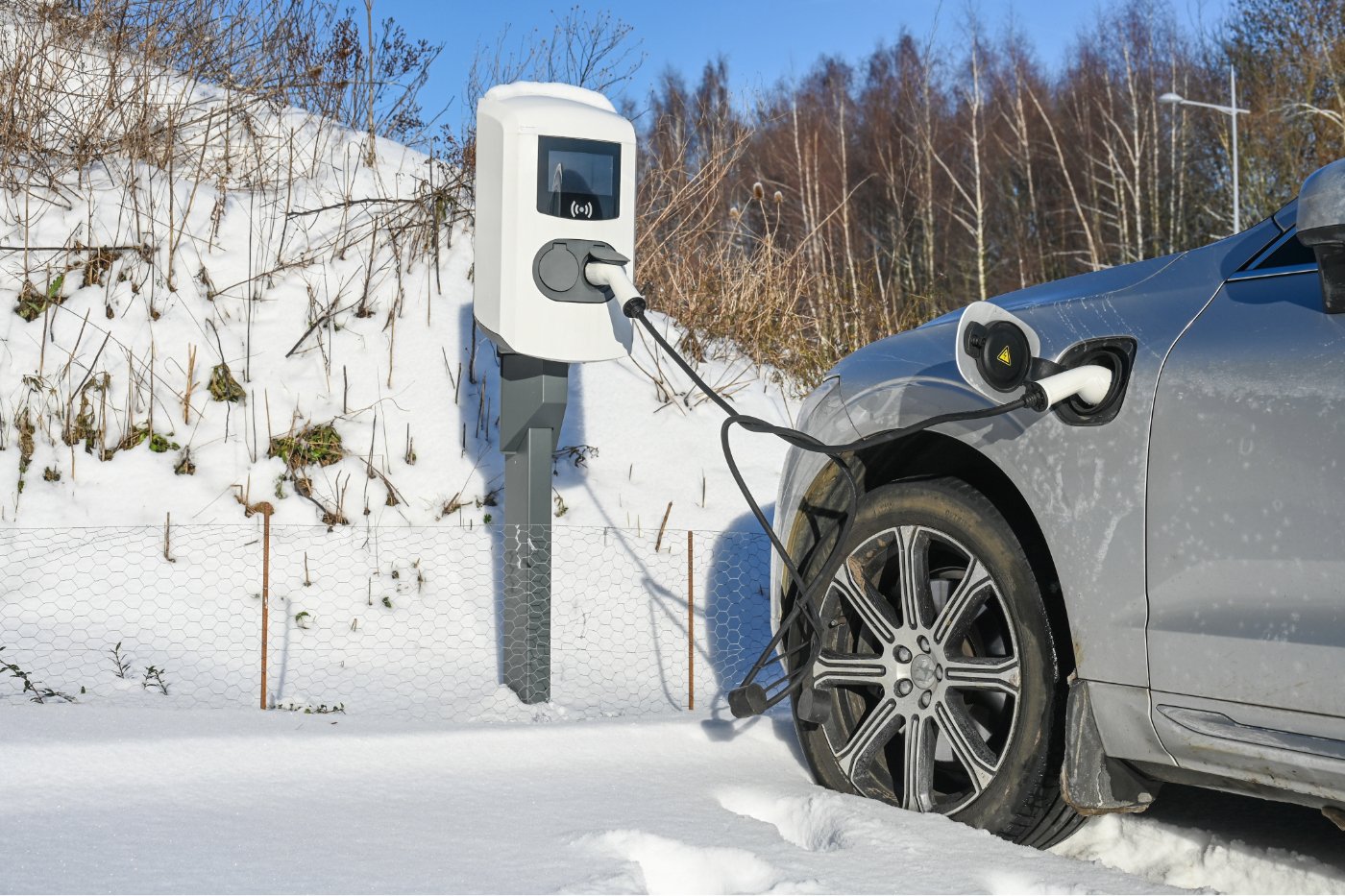
    En hiver, les batteries des voitures électriques sont davantage sollicitées et pour cause : il faut bien chauffer l'habitacle, en plus d'alimenter le moteur bien sûr. Une étude canadienne propose une solution très controversée pour préserver sa batterie durant la saison froide.
    • chevron_right

      L’IA a (très) soif : elle engloutit déjà autant d’eau que toutes les bouteilles bues sur la planète

      news.movim.eu / JournalDuGeek • 5 January

    Eau Bouteille

    Un pillage hydrique en bonne et due forme, devant lequel la complaisance des gouvernements mondiaux commence sérieusement à faire grincer des dents. Êtes-vous vraiment prêts à mourir de soif pour continuer à gaver des modèles d’IA toujours plus voraces ?
    • chevron_right

      Research roundup: 7 cool science stories we almost missed

      news.movim.eu / ArsTechnica • 1 January

    It’s a regrettable reality that there is never enough time to cover all the interesting scientific stories we come across each month. In the past, we’ve featured year-end roundups of cool science stories we (almost) missed. This year, we’ve experimented with a monthly collection. December’s list includes a fossilized bird that choked to death on rocks; a double-detonating "superkilonova"; recovering an ancient seafarer's fingerprint; the biomechanics of kangaroo movement; and cracking a dark matter puzzle that stumped fictional physicists on The Big Bang Theory , among other tantalizing tidbits

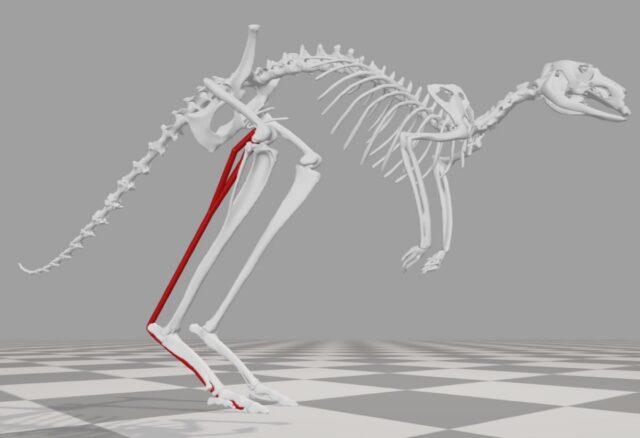
    Secrets of kangaroo posture

    An illustration of the 3D musculoskeletal model of a kangaroo, developed by Lauren Thornton and colleagues. Credit: Thornton et al., 2025/CC BY 4.0

    Kangaroos and wallabies belong to a class of animals called macropods, with unique form and style of movement. Their four limbs and tail all contact the ground at slow speeds, while they use a hopping gait at higher speeds. Typically, high-speed movements are more energy-intensive than slow-speed motion, but the opposite is true for macropods like kangaroos; somehow the hopping speed and energy cost become uncoupled. According to a paper published in the journal eLife, this may be due to changes in a kangaroo's posture at higher hopping speeds.

    Read full article

    Comments